Digital Marketing Agency for Restaurants in Noida: Strategies to Attract More Customers
Digital Marketing Agency for Restaurants in Noida: Strategies to Attract More Customers
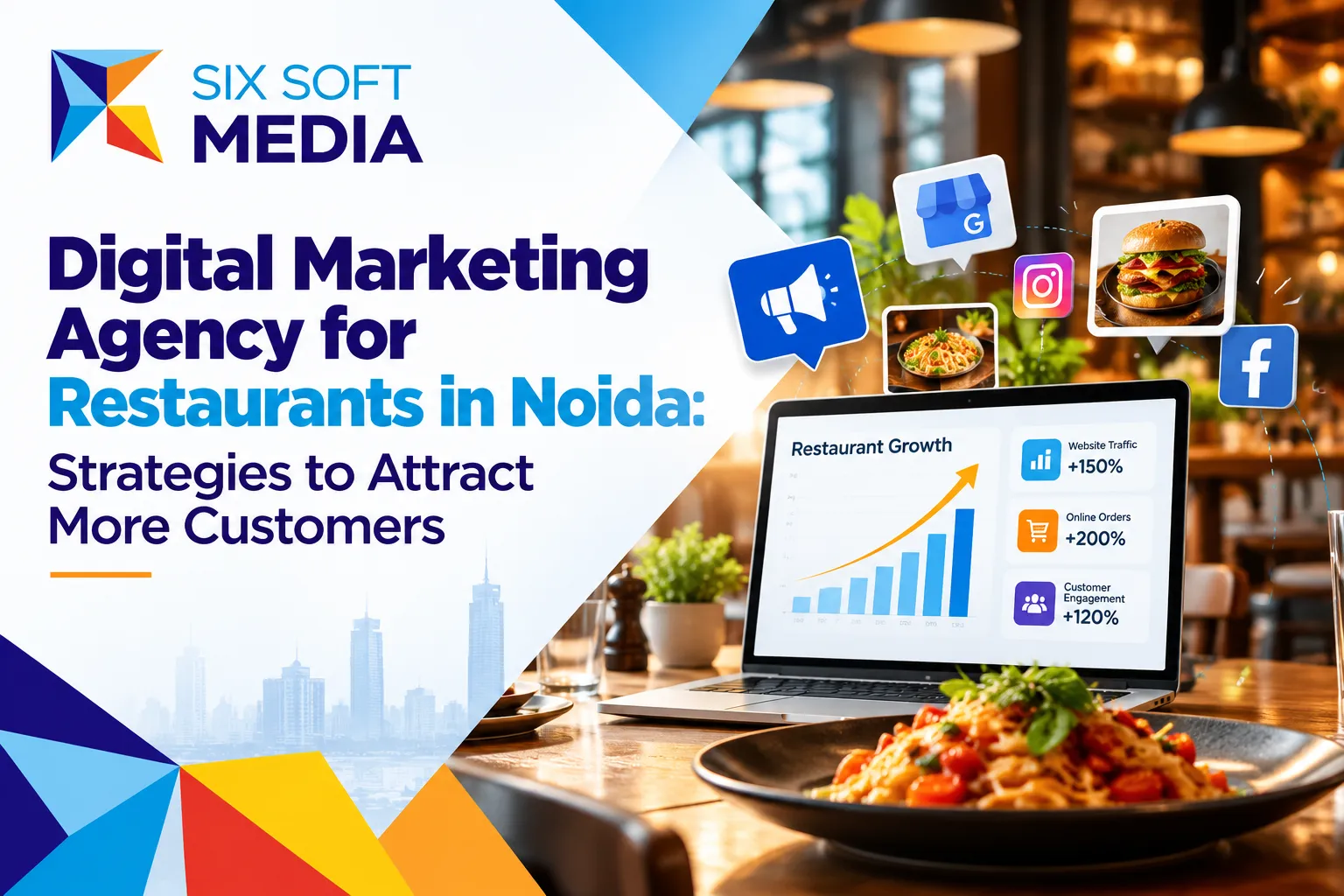
Running a restaurant in Noida takes more than serving delicious food and offering a welcoming dining experience. With customers exploring new cafés, checking restaurant reviews, scrolling through food videos, and comparing dining options online, having a strong digital presence has become essential for attracting attention.
Whether you operate a family restaurant in Sector 62, a café in Sector 18, or a cloud kitchen serving residential areas, potential customers may discover your business through Google Search, Google Maps, Instagram, or online food delivery platforms before deciding to order or visit.
This is where a Digital Marketing Agency for Restaurants can help. By combining local SEO, social media promotion, targeted advertising, and customer engagement strategies, restaurants can improve their online visibility and create more opportunities for reservations, walk-ins, and food orders.
For restaurant owners in Noida, the objective should not be limited to gaining followers or website visitors. A successful restaurant marketing strategy should help the right customers discover your business, explore your offerings, and take action.
Why Do Restaurants in Noida Need Digital Marketing?
Noida has a varied dining market, including casual restaurants, cafés, quick-service outlets, premium dining establishments, and cloud kitchens. Different customers also have different expectations.
Office professionals may search for nearby lunch options, families may compare restaurants for weekend dining, and young customers may discover new cafés through Instagram recommendations.
If a restaurant has limited visibility across these digital channels, it may miss potential customers who are actively looking for places to eat.
A well-planned digital marketing strategy for restaurants can help businesses:
- Improve visibility in relevant Google searches and Google Maps results.
- Attract potential diners from nearby residential and commercial areas.
- Promote menus, special offers, seasonal dishes, and restaurant events.
- Increase awareness through social media marketing for restaurants.
- Generate enquiries for reservations, group dining, and catering.
- Encourage repeat visits through customer engagement and loyalty initiatives.
Instead of treating digital marketing as an occasional promotional activity, restaurant owners can use it as an ongoing way to connect with their local audience.
How Can a Digital Marketing Agency for Restaurants Help Attract More Customers?
A Digital Marketing Agency for Restaurants helps hospitality businesses plan and manage online marketing activities based on their customer base, service model, location, and business objectives.
For example, a dine-in restaurant may want to increase weekend reservations, while a cloud kitchen may prioritise online food orders. A new café might initially focus on brand awareness and local discovery.
An effective approach starts by understanding these differences rather than applying the same advertising campaign to every restaurant.
Here are the important strategies restaurant owners in Noida should consider.
1. Local SEO to Reach Customers Searching for Restaurants Nearby
When customers want to find somewhere to eat, they often search Google using phrases such as “restaurants near me”, “family restaurants in Noida”, or “cafés in Sector 18 Noida”.
These searches reflect local dining interests and may indicate that someone is comparing available options.
Local SEO for restaurants focuses on helping search engines and customers understand a restaurant’s location, food offerings, opening hours, and other relevant information.
Important activities include:
- Creating accurate restaurant pages with location and contact information.
- Optimizing website content around relevant cuisine and location searches.
- Ensuring consistent business details across appropriate directories.
- Improving mobile website usability and navigation.
- Publishing useful information about menus, dining options, and services.
For example, a restaurant offering North Indian cuisine near Sector 62 should clearly communicate its cuisine, location, operating hours, and reservation options.
A restaurant SEO agency can also identify technical website problems and content opportunities that may affect organic search visibility.
The goal is to help customers find information that matches what they are looking for, without filling pages with unnecessary location keywords.
2. Google Business Profile Optimization for Better Local Visibility
A restaurant’s Google Business Profile is often one of the first places customers check before visiting.
People use business profiles to explore photos, read reviews, check opening hours, find directions, and access contact information.
Effective Google Business Profile optimization involves keeping important information complete and accurate.
Restaurant owners should regularly review:
- Business name, address, phone number, and opening hours.
- Relevant restaurant categories and available attributes.
- Original food, ambience, seating, and exterior photographs.
- Menu information and applicable ordering or booking links.
- Customer questions, reviews, and business updates.
For a restaurant in Noida, genuine photographs of its dishes and dining environment can help potential visitors understand what to expect.
Customer reviews are equally important. Responding professionally to both positive and negative feedback demonstrates attentiveness and helps address concerns.
However, restaurants should never purchase reviews or offer incentives specifically in exchange for positive ratings.
A complete profile can improve the customer experience and support local discoverability, although appearing in Google’s top local results is not guaranteed.
3. Social Media Marketing to Build Restaurant Awareness
Food is highly visual, making Instagram and Facebook useful channels for showcasing restaurant experiences.
Through restaurant social media marketing, businesses can introduce their signature dishes, highlight ambience, communicate offers, and share experiences that encourage customers to explore their menu.
Instead of publishing only promotional graphics, restaurants can create content that feels relevant to their audience.
Consider these restaurant marketing ideas:
- Short videos showing the preparation of popular dishes.
- Behind-the-scenes content featuring chefs and kitchen teams.
- Photos of the restaurant’s interior and seating arrangements.
- Videos introducing new menu items or seasonal specials.
- Posts highlighting weekday lunch menus or family dining experiences.
- Customer testimonials and user-generated content shared with permission.
For example, a café in Sector 18 could publish a short video introducing its latest coffee menu, accompanied by clear location information and a simple invitation to visit.
Consistency matters, but publishing valuable content is more useful than posting frequently without a clear purpose.
A restaurant digital marketing agency can develop a content calendar based on dining occasions, customer interests, and business priorities.
4. Google Ads to Reach Customers with Immediate Dining Intent
Organic visibility is valuable, but restaurants may also use paid advertising to reach customers who are actively searching for dining options.
Google Ads for restaurants can help promote relevant offerings through search advertising, depending on campaign eligibility, targeting settings, and available advertising formats.
For instance, a family restaurant might advertise for searches related to family dining in Noida, while a restaurant offering catering may target relevant catering enquiries.
An effective campaign should connect the advertisement with a useful destination where customers can see the menu, location, pricing information, or reservation options.
Restaurant owners should consider:
- Choosing relevant search terms.
- Applying suitable geographic targeting.
- Excluding irrelevant searches where appropriate.
- Creating advertisements that accurately reflect available services.
- Monitoring calls, reservation enquiries, and other meaningful actions.
- Adjusting advertising spend based on campaign performance.
Businesses should avoid judging success only by ad clicks. A campaign that generates numerous clicks but few relevant enquiries may need improvement.
For restaurants, restaurant PPC advertising should be evaluated according to actual business objectives.
5. Instagram and Facebook Ads for Restaurant Promotions
Not every potential customer is actively searching for a restaurant. Some discover dining options while browsing social media.
Facebook and Instagram advertising can help restaurants introduce their offerings to selected audiences based on available targeting options.
For example, a new restaurant launching in Noida could advertise its opening, introduce the menu, and showcase its dining space.
A café could promote a weekend event, while a restaurant with group dining facilities could highlight its suitability for celebrations.
Successful campaigns require more than attractive pictures. They also need clear messaging and a relevant call to action.
Useful creative elements include high-quality food photography, short videos, genuine restaurant visuals, and easily understandable offers.
Restaurant owners should ensure that promotions communicate relevant conditions and do not make misleading claims.
6. Website Optimization to Turn Online Visitors into Customers
A restaurant website acts as a central source of information for customers looking beyond social media and directory listings.
An effective restaurant website design should make important details easy to access, particularly on mobile devices.
Visitors should be able to find the menu, location, operating hours, contact details, and available reservation or ordering methods without unnecessary steps.
For restaurants seeking more direct enquiries, website features may include:
- Clear menu categories and readable descriptions.
- Click-to-call and WhatsApp contact options.
- Accurate directions to the restaurant.
- Accessible booking or enquiry forms.
- Information about private dining, events, or catering.
- Fast-loading pages and mobile-friendly navigation.
For instance, if a customer discovers a restaurant through Google and visits its website, an easily accessible reservation option can reduce friction in the booking process.
Conversion rate optimization for restaurants focuses on improving these customer journeys, making it simpler for interested visitors to complete meaningful actions.
7. Online Reputation Management to Build Customer Confidence
Customer reviews can influence how people evaluate restaurants, especially when choosing somewhere unfamiliar.
A strong online reputation management strategy involves monitoring feedback, responding professionally, and addressing recurring service concerns.
Restaurants should encourage genuine customer feedback without pressuring diners or selectively requesting positive reviews.
If a customer raises an issue about service speed, food quality, or billing, the restaurant should acknowledge the concern and investigate it through appropriate channels.
Digital marketing can amplify a restaurant’s reputation, but it cannot replace reliable food quality, good service, and a positive customer experience.
This is why marketing and restaurant operations should work together.
8. WhatsApp Marketing and Customer Retention
Attracting first-time diners is important, but building lasting customer relationships can create additional opportunities for repeat business.
With appropriate customer consent, restaurants can use WhatsApp marketing for restaurants to communicate useful updates such as reservation confirmations, new menu announcements, or relevant promotional offers.
A restaurant can also introduce simple loyalty initiatives that encourage returning customers to visit again.
Possible approaches include birthday offers, regular-customer benefits, special menu previews, and feedback requests.
However, excessive promotional messaging can frustrate customers. Restaurants should respect communication preferences, obtain required permissions, and provide suitable opt-out options.
A good customer retention strategy for restaurants focuses on relevance, service quality, and convenience rather than sending frequent advertisements.
Marketing Strategies for Different Types of Restaurants in Noida
Every restaurant serves a different audience, so its digital marketing priorities should reflect the business model.
| Restaurant type | Marketing priorities |
|---|---|
| Family restaurants | Local SEO, Google Maps visibility, reviews, group booking enquiries |
| Cafés and coffee shops | Instagram content, local discovery, events, visual storytelling |
| Cloud kitchens | Delivery-platform listings, menu presentation, repeat ordering |
| Fine-dining restaurants | Brand positioning, professional photography, reservations |
| Quick-service restaurants | Nearby customer targeting, convenience, offers, repeat visits |
| New restaurants | Launch awareness, accurate business listings, introductory campaigns |
For a newly opened restaurant, creating local awareness may be the initial objective. An established business might instead focus on increasing weekday traffic or strengthening customer retention.
A restaurant Digital marketing agency should evaluate these priorities before recommending an advertising budget or content strategy.
A Practical 30-Day Digital Marketing Plan for Restaurants in Noida
Restaurant owners who want to organize their marketing efforts can begin with a structured four-week plan.
Week 1: Audit Your Online Presence
Review your restaurant’s website, Google Business Profile, social media accounts, menu links, and major customer review platforms.
Identify inaccurate information, outdated photographs, missing contact details, and difficulties customers may face when trying to book or order.
Also establish baseline figures such as website enquiries, bookings, calls, and online orders where reliable data is available.
Week 2: Improve Local Discovery
Update important business information, improve relevant website pages, and publish original photographs of the restaurant and its food.
Ensure customers can easily understand where the restaurant is located, what it offers, and how to contact it.
For businesses with several outlets, maintain accurate information for each genuine location.
Week 3: Launch Focused Promotional Campaigns
Develop a small set of social media creatives and test advertising campaigns based on the restaurant’s immediate objectives.
For example, a new café might focus on local awareness, while an established restaurant may prioritize weekday lunch enquiries.
Start with a manageable budget and review results before increasing spending.
Week 4: Measure Results and Refine the Strategy
Examine the actions generated through marketing activities.
Which channels produced genuine customer enquiries? Which promotions attracted relevant attention? Were customers able to complete bookings or orders successfully?
Use these findings to improve content, targeting, and the overall customer experience.
The purpose of a 30-day plan is to establish an effective process, not to promise a particular number of customers within a fixed period.
How Much Should Restaurants in Noida Spend on Digital Marketing?
There is no single advertising budget suitable for every restaurant.
Marketing costs depend on several factors, including the restaurant’s category, competition, customer acquisition objectives, creative requirements, and chosen advertising channels.
A new café promoting its opening may need a different spending approach from an established restaurant trying to increase reservations.
Before allocating a budget, identify the business result you want to achieve.
For example, if a campaign costs ₹12,000 and generates 40 confirmed new-customer orders attributable to the campaign, the advertising cost per acquired customer would be ₹300.
That figure alone does not establish profitability. Restaurant owners must also consider order value, food costs, packaging, discounts, platform fees, and other relevant expenses.
This approach makes restaurant marketing ROI more meaningful than simply tracking impressions or likes.
How to Choose the Right Restaurant Digital Marketing Agency in Noida
Choosing a marketing partner requires more than comparing monthly service packages.
A suitable restaurant Digital marketing agency should understand how restaurant customers discover, compare, and choose dining options.
Before hiring an agency, consider asking:
- How will you identify the restaurant’s target audience and local competitors?
- Which channels should we prioritize and why?
- How will you measure reservation enquiries, calls, orders, and customer acquisition?
- What reporting will be provided, and how frequently?
- How will your strategy differ for a café, cloud kitchen, or family restaurant?
- What work is included in the management fee, and what advertising costs are separate?
Look for transparent communication, relevant experience, realistic expectations, and clear explanations of proposed activities.
Be cautious of agencies that promise guaranteed first-position rankings or fixed revenue growth without assessing the restaurant’s circumstances.
Why Consider Sixsoftmedia for Restaurant Digital Marketing in Noida?
Restaurant marketing works best when business objectives and digital activities are connected.
For businesses considering Sixsoftmedia, a useful starting point is to identify the specific problem marketing needs to address.
Is the restaurant struggling with local discovery? Does its website receive visitors but produce few enquiries? Is the business launching a new outlet or trying to attract more weekday customers?
As a digital marketing agency in Noida, Sixsoftmedia can position its restaurant marketing offering around understanding these challenges and recommending appropriate digital strategies.
Potential areas of support include local search engine optimization, Google Business Profile improvement, social media marketing, paid advertising, website optimization, and digital performance analysis, subject to the services offered.
The most important consideration is whether the proposed work aligns with the restaurant’s location, customer preferences, operating capacity, and budget.
Conclusion
Restaurant marketing in Noida requires a clear understanding of how local customers discover dining options and make purchasing decisions.
From restaurant local SEO and Google Maps visibility to targeted advertising, social media content, and customer retention, each channel can contribute to a stronger customer acquisition strategy.
The right approach is not necessarily the one with the largest advertising budget. It is the one that connects relevant marketing activities with customer needs, business priorities, and measurable outcomes.
Working with a Digital Marketing Agency for Restaurants can help restaurant owners organize these activities and make more informed decisions about their online growth.
Ready to Attract More Customers to Your Restaurant in Noida?
Your restaurant deserves to be discovered by customers who are looking for the dining experience you offer.
Whether you manage a café, family restaurant, cloud kitchen, or newly launched food business, Sixsoftmedia can be your starting point for discussing a digital marketing strategy tailored to your goals.
Contact Sixsoftmedia today and take the next step toward growing your restaurant’s digital presence.
FAQs
1. What does a Digital Marketing Agency for Restaurants do?
A Digital Marketing Agency for Restaurants helps restaurant businesses improve online visibility, reach relevant customers, manage digital campaigns, and encourage actions such as enquiries, reservations, and food orders. Services may include SEO, social media management, paid advertising, content marketing, and website optimization.
2. Which digital marketing strategy is best for restaurants in Noida?
The most suitable strategy depends on the restaurant’s objectives. Local SEO and an accurate Google Business Profile are useful starting points for businesses seeking nearby customers, while social media and paid advertising may support awareness and promotions.
3. Can digital marketing help a newly opened restaurant in Noida?
Yes. Digital marketing for new restaurants can help introduce the business to nearby customers through local listings, launch announcements, original food content, and appropriately targeted advertising. The results will depend on the restaurant’s offering, execution, market conditions, and customer experience.
4. Is SEO important for restaurants that already use Zomato and Swiggy?
Yes. SEO for restaurants can support discovery through Google Search and the restaurant’s own website, while food delivery platforms provide additional ordering and discovery channels. Each can play a different role in the customer journey.
5. How long does restaurant SEO take to show results?
SEO is an ongoing process. Timelines vary based on competition, the restaurant’s existing online presence, website quality, and the work required. Improvements may appear gradually, but no responsible agency can guarantee a particular ranking or timeframe.
6. How can restaurants measure digital marketing success?
Restaurants can measure relevant indicators such as reservation enquiries, calls, online orders, campaign-attributed visits, customer acquisition cost, repeat purchases, and revenue where reliable tracking is possible. These measures are generally more useful than judging performance only by follower counts.
Top 10 Digital Marketing Companies in Noida
In today’s digital world, having a strong online presence is essential for every business. Customers are spending more time online, and companies need effective digital strategies to reach their target audience, generate leads, and build brand awareness.
Digital marketing helps businesses promote their products and services through online platforms. It includes various services such as Search Engine Optimization (SEO), Social Media Marketing, Google Ads, content marketing, website development, branding, and online reputation management. Pasted markdown
Noida has become one of the major technology and business hubs in India, with many professional digital marketing agencies helping startups, small businesses, and enterprises achieve online growth.
Choosing the right digital marketing company can be challenging because every business has different goals. Before hiring an agency, businesses should check experience, services, client reviews, industry expertise, and marketing strategies. Pasted markdown
In this blog, we have listed the Top 10 Digital Marketing Companies in Noida that provide complete digital solutions to help businesses grow online.
1. Sixsoftmedia – Your Growth Partner in Digital Marketing
About Sixsoftmedia
Sixsoftmedia is a leading digital marketing company based in Noida, helping businesses improve their online visibility and achieve sustainable growth through innovative digital strategies.
Founded in 2013, Sixsoftmedia has more than 10 years of experience in digital marketing. The company has a team of digital marketers, SEO specialists, designers, developers, and strategists who work together to create result-oriented marketing campaigns.
Sixsoftmedia focuses on understanding business goals and creating customized digital marketing solutions that help brands attract customers, increase website traffic, and generate quality leads.
The company does not only focus on marketing campaigns but also builds long-term digital growth strategies for businesses.
Sixsoftmedia Highlights
✅ 10+ Years of Digital Excellence
✅ 500+ Clients Served
✅ 98% Client Retention
✅ Google Certified Agency
✅ Award-Winning Team
✅ Transparent Reporting
✅ 24×7 Support
Services Offered by Sixsoftmedia
Search Engine Optimization (SEO)
Sixsoftmedia provides SEO services to improve website rankings on search engines, increase organic traffic, and help businesses reach potential customers.
Google Ads & PPC Marketing
The company creates targeted paid advertising campaigns to help businesses generate leads and achieve better returns on investment.
Social Media Marketing
Sixsoftmedia helps brands grow on social media platforms through creative content, audience engagement, and strategic campaigns.
Website Design & Development
The company creates modern, responsive, and user-friendly websites designed to improve customer experience and conversions.
Content Marketing
SEO-friendly content strategies help businesses increase online visibility and establish brand authority.
Lead Generation
Sixsoftmedia creates digital campaigns focused on attracting potential customers and increasing business opportunities.
Why Choose Sixsoftmedia?
- Experienced digital marketing professionals
- Customized marketing strategies
- Transparent campaign reporting
- Latest digital marketing techniques
- Complete online growth solutions
Company Details
Company Name: Sixsoftmedia
Location: C-372, Sector 10, Noida, UP – 201309
Website: www.sixsoftmedia.com
2. Digital Notebook – A Digital Marketing Agency
About Digital Notebook
Digital Notebook is one of the top digital marketing companies based in Noida, India. The company provides professional marketing services to help businesses improve their online presence and achieve better results. Pasted markdown
With a skilled and experienced team, Digital Notebook works on modern digital marketing strategies to help businesses increase visibility, improve search rankings, and attract more customers. Pasted markdown
The company provides complete digital marketing solutions including SEO, social media marketing, paid advertising, website development, and lead generation.
Services Provided by Digital Notebook
Search Engine Optimization (SEO)
Digital Notebook provides SEO services to improve website rankings and increase organic traffic.
Social Media Marketing
The company helps businesses build their social media presence and connect with customers.
Google Ads
Digital Notebook manages paid advertising campaigns to generate targeted leads.
Website Design
The company provides custom website design solutions for businesses.
Shopify Website Design
They offer Shopify website development services for eCommerce businesses.
Lead Generation
Digital Notebook creates strategies to help businesses generate more customer inquiries.
Why Choose Digital Notebook?
- Experienced marketing professionals
- SEO-focused strategies
- Digital branding solutions
- Result-oriented campaigns
- Business growth approach
Digital Notebook Contact Details
Address: LGF, 146 & 147, H Block, Sector 63, Noida, Uttar Pradesh 201301
Email: info@digitalnotebook.in
Phone: +91 9953606208
Website:www.digitalnotebook.in
3. eCom Conversion – eCommerce Marketing Agency
About eCom Conversion
eCom Conversion is an eCommerce marketing agency in Noida that helps businesses achieve their online sales goals through strategic campaigns, consulting, advertising, and development solutions. Pasted markdown
The company focuses on improving eCommerce performance by implementing effective marketing strategies and conversion optimization techniques.
Services Provided by eCom Conversion
- Media Buying
- eCommerce Consulting
- Conversion Rate Optimization
- eCommerce Analyst Services
- eCommerce SEO
- eCommerce Web Development
Pasted markdown
Why Choose eCom Conversion?
- eCommerce-focused strategies
- Performance marketing solutions
- Sales improvement approach
- Experienced marketing team
Contact Details
Address: H-61, 3rd Floor (Suite 04), Sector 63, Noida 201301, Uttar Pradesh, India
Email: connect@ecomconversion.com
Phone:+91 70422 88 300
Website: www.ecomconversion.com
4. Webi360 – Digital Marketing & Web Development Company
About Webi360
Webi360 is a well-known digital marketing and web development company in Noida that provides complete 360-degree digital solutions for businesses. The company helps brands improve their online presence through digital marketing strategies, website development, branding, and social media solutions. Pasted markdown
Webi360 focuses on creating customized marketing solutions according to business requirements. Their experienced team works on improving brand visibility, increasing customer reach, and building a strong digital identity. Pasted markdown
The company provides solutions for businesses looking to establish their presence online through creative designs, marketing campaigns, and technology-driven services.
Services Provided by Webi360
Website Design and Development
Webi360 develops professional websites that help businesses create a strong online presence.
Branding and Designing
The company provides creative branding solutions to help businesses build recognition.
eCommerce Solutions
Webi360 helps businesses develop and promote online stores.
Digital Marketing Strategy
The company creates customized digital strategies according to business goals.
Social Media Marketing
Webi360 helps businesses increase engagement and reach through social media platforms.
Online Reputation Management
The company provides solutions to manage and improve brand reputation online.
Pasted markdown
Why Choose Webi360?
- Complete 360-degree digital solutions
- Experienced digital marketing team
- Customized strategies
- Branding and technology expertise
- Business-focused marketing approach
Webi360 Contact Details
Address: S77, Plot No. C, 1, NPX Tower, Noida-Greater Noida Expressway, Sector 153, Noida
Email: contact@webi360.in
Phone: +91 8851765282
Website: www.webi360.in
5. Bharat Arpanet – Digital Marketing & Technology Solutions
About Bharat Arpanet
Bharat Arpanet is a digital marketing agency in Noida that provides complete digital solutions for businesses. The company offers services including website development, mobile applications, search engine solutions, PPC advertising, marketing automation, and social media marketing. Pasted markdown
The company focuses on providing creative and productive solutions to help businesses improve their online presence and achieve digital growth.
Bharat Arpanet works with businesses that need technology solutions combined with effective marketing strategies.
Services Provided by Bharat Arpanet
Website Development
The company develops professional websites according to business requirements.
Mobile App Development
Bharat Arpanet creates mobile applications to help businesses connect with customers.
Search Engine Development
The company provides search-based technology solutions.
Pay Per Click (PPC)
Bharat Arpanet manages paid advertising campaigns for better visibility.
Marketing Automation
The company provides automation solutions to improve marketing efficiency.
Social Media Marketing
They help businesses increase engagement and brand awareness through social media.
Pasted markdown
Why Choose Bharat Arpanet?
- Digital marketing and technology expertise
- Customized business solutions
- Creative approach
- Experienced professionals
Bharat Arpanet Contact Details
Address: 206 Second Floor Tower 1, Assotech Business Cresterra Plot No-22, Sector 135, Noida – 201301 (Uttar Pradesh), India
Email: contact@bharatarpanet.com
Phone: +91-9971359665
Website: www.bharatarpanet.com
6. Techmagnate – SEO & Digital Marketing Company
About Techmagnate
Techmagnate is an SEO service and digital marketing company providing digital growth solutions for businesses. The company focuses on improving online visibility through SEO, paid advertising, website solutions, reputation management, and content marketing. Pasted markdown
Techmagnate provides complete digital marketing strategies from planning to execution. Their team works on implementing solutions designed to support business growth.
Services Provided by Techmagnate
Search Engine Optimization (SEO)
Techmagnate provides SEO strategies to improve search rankings and organic visibility.
Pay Per Click (PPC)
The company manages paid advertising campaigns to attract targeted audiences.
Website Designing and Development
Techmagnate creates websites designed for better user experience.
Online Reputation Management
The company helps businesses maintain a positive online presence.
eCommerce Solutions
They provide digital solutions for online businesses.
App Store Optimization
Techmagnate helps improve mobile app visibility.
Video Marketing and YouTube SEO
The company provides video marketing solutions.
Conversion Rate Optimization
They help businesses improve website conversions.
Content Marketing
Techmagnate develops content strategies to support digital growth.
Pasted markdown
Why Choose Techmagnate?
- SEO expertise
- Complete digital marketing solutions
- Experienced professionals
- Growth-focused strategies
Techmagnate Contact Details
Address: A-24/8, 1st Floor, Rathi Tower, Mohan Cooperative Industrial Estate, Mathura Road, New Delhi -110044
Email: enquiry@techmagnate.com
Phone: +91-9910308266
Website: www.techmagnate.com
7. Garage Media – Creative Branding & Digital Marketing Agency
About Garage Media
Garage Media is a branding and creative agency in Noida that provides innovative marketing ideas and creative solutions for businesses. The company focuses on creating meaningful campaigns aligned with customer needs and business objectives. Pasted markdown
The agency works on developing creative strategies that help brands improve their visibility and connect with their audience.
Services Provided by Garage Media
- Digital Marketing
- Social Media Marketing
- Influencer Marketing
- Search Engine Optimization (SEO)
- Web Development
- Content Marketing
Pasted markdown
Why Choose Garage Media?
- Creative marketing solutions
- Branding expertise
- Social media campaigns
- Customer-focused strategies
Garage Media Contact Details
Address: Units 3, 4, 5 – 5th Floor Wave Mall, Sector-18, Noida-201301
Email: saurabh@garagemedia.net
Phone: +91 9910052488
Website: www.garagemedia.net
8. Digidir – Digital Marketing & Branding Company
About Digidir
Digidir is a digital marketing company in Noida that provides complete digital solutions including branding, online marketing, and website development services. The company focuses on helping businesses improve their digital presence, increase website traffic, and build a stronger online identity. Pasted markdown
With a team of professional and skilled experts, Digidir works on customized strategies based on business requirements. The company provides solutions that help brands improve visibility, attract customers, and grow in the competitive digital marketplace.
Services Provided by Digidir
Branding Solutions
Digidir helps businesses create a strong brand identity through creative branding strategies.
Digital Marketing
The company provides online marketing solutions to improve business reach and customer engagement.
Website Development
Digidir develops professional websites designed to support business growth.
Pasted markdown
Why Choose Digidir?
- Professional digital marketing team
- Customized marketing strategies
- Branding and development expertise
- Business growth-focused solutions
Digidir Contact Details
Address: First Floor, H-187, Sector 63, Noida, Uttar Pradesh, India
Email: info@digidir.com
Phone: +91-9999340468
Website: www.digidir.com
9. Digistreet Media – Creative Digital Marketing Agency
About Digistreet Media
Digistreet Media is a creative digital marketing company in Noida that provides innovative marketing solutions with a creative approach. The company follows a 360-degree digital strategy to help brands improve their online presence and achieve business objectives. Pasted markdown
The agency focuses on creating unique marketing ideas that support brand growth. Their team works on creative communication, advertising, technology, and digital marketing solutions to help businesses connect with their target audience.
Services Provided by Digistreet Media
Creative Communication
Digistreet Media develops creative concepts and communication strategies for brands.
Search Engine Marketing (SEM)
The company provides paid search marketing solutions to improve online visibility.
Digital Marketing
They create complete online marketing strategies for businesses.
Web and App Development
Digistreet Media develops websites and applications according to business requirements.
Advertisement Management
The company manages digital advertising campaigns for better reach.
Content Marketing
They create content strategies to improve brand awareness and engagement.
Social Media Marketing
The company helps businesses grow their presence across social platforms.
Online Reputation Management
Digistreet Media provides solutions to maintain and improve brand reputation.
Pasted markdown
Why Choose Digistreet Media?
- Creative marketing approach
- Complete digital solutions
- Branding and communication expertise
- Customer-focused strategies
Digistreet Media Contact Details
Address: 2nd Floor, B49 Sector 64, Noida Uttar Pradesh – 201301
Email: info@digistreetmedia.com
Phone: +91-9999668900
Website: www.digistreetmedia.com
10. Digipanda – Digital Marketing & Technology Solutions
About Digipanda
Digipanda is a digital marketing agency in Noida providing web, marketing, and technology solutions for businesses. The company has a team of professionals who focus on creating effective digital solutions through creative designs and customer-focused strategies. Pasted markdown
Digipanda helps businesses improve their online identity through website development, SEO, paid advertising, social media marketing, and branding solutions.
Services Provided by Digipanda
Website Design
Digipanda creates professional and responsive websites for businesses.
Search Engine Optimization (SEO)
The company provides SEO services to improve online visibility.
Pay Per Click (PPC)
Digipanda manages paid campaigns to generate targeted traffic.
Social Media Marketing
The company helps businesses improve engagement and brand awareness.
Brand Identity
Digipanda develops creative branding solutions.
Mobile App Development
The company provides mobile application development services.
Pasted markdown
Why Choose Digipanda?
- Skilled digital professionals
- Creative design solutions
- Complete digital marketing services
- Technology-driven approach
Digipanda Contact Details
Address: D-111, Floor No.1, Sector 63, Noida, India
Email: info@digipanda.co.in
Website: www.digipanda.co.in
11. Techcentrica – Digital Marketing & IT Solutions Company
About Techcentrica
Techcentrica is a digital marketing company in Noida that provides results-oriented digital solutions for businesses. The company also has a branch in Melbourne, Australia, and focuses on delivering professional digital services to clients. Pasted markdown
Techcentrica helps businesses improve their digital presence through marketing strategies, website development, eCommerce solutions, and technology services.
Services Provided by Techcentrica
Digital Marketing
Techcentrica creates online marketing strategies to improve brand visibility.
Search Engine Marketing (SEM)
The company provides paid search solutions to attract potential customers.
Social Media Marketing
They help businesses build engagement through social platforms.
Web Design and Development
Techcentrica develops websites that support business goals.
eCommerce Solutions
The company provides solutions for online businesses.
Portal Development
They create customized web portals.
Content Marketing
Techcentrica develops content strategies for online growth.
Reputation Management
The company helps businesses manage their online reputation.
Pasted markdown
Why Choose Techcentrica?
- Results-oriented digital solutions
- Experienced professionals
- Digital marketing and technology expertise
- Business-focused strategies
Techcentrica Contact Details
Address: H-73, Level 4, Sector 63 (Near Haldiram), Noida 201301
Email: sales@techcentrica.com
Phone: 0120 – 4322549
Website: www.techcentrica.com
Comparison Table – Top Digital Marketing Companies in Noida
| Rank | Company Name | Main Services | Location |
|---|---|---|---|
| 1 | Sixsoftmedia | SEO, PPC, Social Media Marketing, Website Development, Branding, Lead Generation | Noida |
| 2 | Digital Notebook | SEO, Google Ads, Social Media Marketing, Website Design, Lead Generation | Sector 63, Noida |
| 3 | eCom Conversion | eCommerce Marketing, Media Buying, CRO, eCommerce SEO, Development | Sector 63, Noida |
| 4 | Webi360 | Digital Marketing, Website Development, Branding, Social Media, ORM | Sector 153, Noida |
| 5 | Bharat Arpanet | Website Development, Mobile Apps, PPC, Automation, Social Media | Sector 135, Noida |
| 6 | Techmagnate | SEO, PPC, Web Development, ORM, Content Marketing | New Delhi |
| 7 | Garage Media | Branding, SEO, Social Media, Influencer Marketing, Content Marketing | Sector 18, Noida |
| 8 | Digidir | Branding, Digital Marketing, Website Development | Sector 63, Noida |
| 9 | Digistreet Media | SEM, Digital Marketing, Creative Communication, Web Development | Sector 64, Noida |
| 10 | Digipanda | SEO, PPC, Website Design, Social Media, Mobile Apps | Sector 63, Noida |
| 11 | Techcentrica | Digital Marketing, SEM, Web Development, eCommerce Solutions | Sector 63, Noida |
Why Businesses Need Digital Marketing Services in Noida?
Noida has become a major business and technology center in India. With increasing competition, businesses need effective digital strategies to reach customers online.
A professional digital marketing agency helps businesses:
1. Increase Online Visibility
SEO and content marketing help businesses improve their presence on search engines and reach potential customers.
2. Generate Quality Leads
Digital advertising campaigns help companies connect with the right audience and generate business inquiries.
3. Build Brand Awareness
Social media marketing and branding strategies help businesses create strong customer relationships.
4. Improve Customer Engagement
Online platforms allow businesses to communicate directly with their customers and understand their needs.
5. Increase Sales and Revenue
A properly planned digital marketing strategy helps businesses attract more visitors and convert them into customers.
Benefits of Hiring a Digital Marketing Company
Professional Expertise
Digital marketing agencies have experienced professionals who understand SEO, advertising platforms, content strategies, and online trends.
Cost-Effective Marketing
Compared with traditional advertising, digital marketing allows businesses to target specific audiences and track campaign performance.
Better Analytics and Reporting
Agencies provide performance reports that help businesses understand campaign results and make better decisions.
Latest Marketing Strategies
Professional agencies continuously update their strategies according to changing digital trends and search engine algorithms.
How to Select the Right Digital Marketing Agency in Noida?
Choosing the right agency is important for achieving business goals. Consider these factors before hiring:
1. Define Your Business Goals
First identify what you want to achieve:
- More website visitors
- Higher search rankings
- More leads
- Better brand awareness
- Increased sales
2. Check Experience
Review the agency’s experience, previous projects, and expertise in your industry.
3. Review Services
Choose an agency that provides services according to your requirements, such as:
- SEO
- PPC
- Social Media Marketing
- Website Development
- Content Marketing
4. Check Client Reviews
Customer feedback and testimonials can help you understand the company’s service quality.
5. Understand Pricing
Discuss pricing, packages, and expected deliverables before starting a project.
Final Conclusion
The digital world is continuously growing, and businesses need strong online strategies to stay competitive. Choosing the right Digital Marketing Agency in Noida can help companies improve visibility, attract customers, and achieve long-term growth.
Noida has several professional digital marketing agencies offering complete solutions, from SEO and advertising to website development and branding.
Companies like Sixsoftmedia, Digital Notebook, eCom Conversion, Webi360, Bharat Arpanet, Techmagnate, Garage Media, Digidir, Digistreet Media, Digipanda, and Techcentrica provide various digital services to support businesses in their online journey.
Before selecting an agency, businesses should carefully evaluate their goals, requirements, and available solutions to find the right digital marketing partner.
FAQs
1. What is digital marketing?
Digital marketing is a way to promote businesses online using SEO, social media, ads, websites, and other digital channels.
2. Why do businesses need digital marketing?
Digital marketing helps businesses reach more customers, increase brand awareness, and generate more leads online.
3. What services do digital marketing companies provide?
Digital marketing companies provide services like SEO, Google Ads, social media marketing, website development, content marketing, and branding.
4. How do I choose the right digital marketing company?
Choose a company based on its experience, services, reviews, and understanding of your business goals.
5. How much does digital marketing cost?
The cost depends on the services you need, your goals, and the size of your marketing campaign.
6. How long does SEO take to show results?
SEO usually takes time. Results depend on competition, website quality, and the SEO strategy used.
7. Can digital marketing help small businesses?
Yes, digital marketing helps small businesses reach more people and grow their online presence.
8. Why should I hire a digital marketing agency?
A digital marketing agency has experts who can create strategies, manage campaigns, and help businesses grow online.
How to Choose the Best SEO Company in Noida?
How to Choose the Best SEO Company in Noida?
If you are planning to grow your business online, choosing the right SEO company in Noida is an important decision. Many agencies offer SEO services, but every agency may not follow the same process or give the same level of service.
A good SEO company should first understand your business, website, customers and competitors. It should then prepare an SEO plan based on your actual business goals. SEO is not only about getting keywords on the first page. It is also about bringing the right visitors to your website and converting them into enquiries, calls or sales.
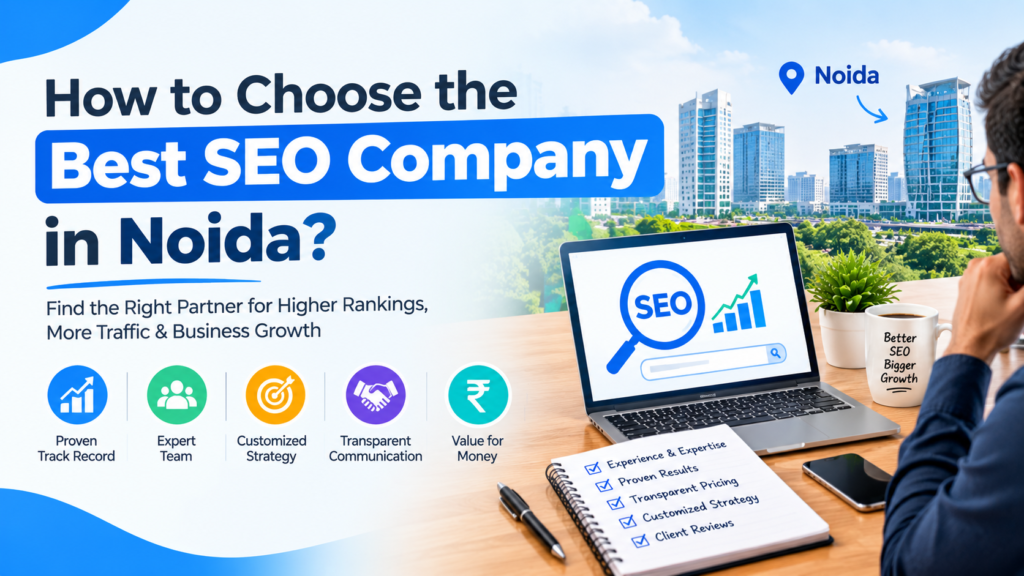
In 2026, SEO is also changing with AI search, better content systems and changes in how people search online. So businesses need an agency that understands both traditional Google SEO and the latest search trends.
If you are searching for the best SEO company in Noida, this guide will help you understand what you should check before hiring an agency.
Why Choosing the Right SEO Company Matters
SEO is usually a long term activity. A business can spend months working on its website, content and backlinks. If the SEO strategy is not right, the money and time spent may not give useful results.
The right SEO company can help you with:
- Better visibility on Google
- More relevant website traffic
- Better keyword rankings
- More local customers
- More enquiries and leads
- Better website structure
- Quality content
- Technical SEO improvements
- Local SEO
- Website conversion improvements
A good SEO agency should also explain what it is doing and why it is doing it. You should not have to depend only on a monthly report filled with keyword positions.
1. Start With Your Business Goals
Before you contact an SEO company in Noida, first decide what you want from SEO.
For example, your goal may be:
- More calls
- More website enquiries
- More online sales
- More visitors to your website
- Better local visibility
- More customers from Noida
- Better rankings for important services
- Growth in a particular product category
Your goal will help the SEO agency prepare the right strategy.
For example, a local doctor may want more calls and appointment enquiries. An e-commerce business may want more product sales. A B2B company may want qualified leads.
So do not choose an agency only because it says it can rank keywords. Ask how the SEO work will help your actual business.
2. Check the SEO Company’s Experience
Experience is one of the first things you should check when comparing SEO companies in Noida.
Ask the agency:
- How many years have you been providing SEO services?
- What type of businesses have you worked with?
- Have you worked in my industry?
- Can you show previous SEO projects?
- What type of websites do you normally handle?
- Who will manage my SEO campaign?
Industry experience can be useful because every business has different customers and competition.
For example, SEO for a school is different from SEO for a manufacturing company. Similarly, SEO for an e-commerce website needs a different approach compared with a local service business.
A good agency should understand these differences before suggesting a plan. Industry experience and a clear strategy are among the important factors businesses should check when comparing SEO agencies.
3. Ask for an SEO Audit Before Starting
A professional SEO company should understand your current website before giving you a final strategy.
Ask for an initial SEO audit.
An audit may check:
Technical SEO
This includes website speed, mobile usability, indexing, crawl issues, broken links and other technical areas.
On Page SEO
This includes:
- Page titles
- Meta descriptions
- Headings
- Content
- Images
- Internal links
- URL structure
- Keyword usage
Off Page SEO
This includes backlinks, website authority and other external signals.
Local SEO
For a business targeting Noida customers, local SEO can be very important. The agency should check your Google Business Profile, local citations, reviews and local landing pages where relevant.
Competitor Analysis
The agency should also check what your competitors are doing. This can show which keywords they rank for, what type of content they publish and where there may be opportunities for your website.
An audit helps both sides understand the current situation before the campaign starts.
4. Look at the SEO Strategy
Avoid choosing an agency only because it offers a large number of services.
Ask the agency to explain what it will actually do for your website.
A proper SEO plan may include:
- Website audit
- Keyword research
- Competitor research
- Technical SEO
- On page SEO
- Content planning
- Internal linking
- Local SEO
- Link building
- Performance tracking
- Monthly reporting
The exact work should depend on your website and business.
There should not be one fixed strategy for every client.
A good agency should create a plan according to your website condition, competition, target audience and business goals. Current SEO hiring guides also recommend checking the actual deliverables, reporting process and strategy instead of comparing agencies only on price.
5. Check Their Keyword Research Process
Keywords are still an important part of SEO, but choosing keywords only because they have high search volume is not enough.
For example, suppose you provide web development services in Noida.
A keyword such as “web development” may have high competition. But terms such as:
- Web development company in Noida
- Website development services in Noida
- E-commerce website development company
- Custom website development services
may be more useful depending on your business.
The SEO company should understand search intent.
Ask:
Why have you selected these keywords for my website?
A good agency should be able to explain the reason behind its keyword selection.
6. Check Their Content Quality
Content plays an important role in SEO.
But publishing a large number of articles every month does not automatically mean better SEO.
The content should:
- Answer the user’s question
- Be easy to understand
- Provide useful information
- Match the search intent
- Use keywords naturally
- Have proper headings
- Include useful internal links
- Support your products or services
Google continues to update its search documentation and SEO guidance, so an SEO company should focus on useful content and a technically accessible website instead of depending on outdated SEO methods.
Ask the agency whether content writing is included in your SEO package.
Also ask:
- Who will write the content?
- Will the content be reviewed?
- How many articles will be published?
- Will the content be written according to search intent?
- Will existing website content also be improved?
7. Check Technical SEO Knowledge
Technical SEO is an important part of a good SEO campaign.
Your website may have good content but still face SEO problems because of technical issues.
An SEO company should be able to identify issues related to:
- Website speed
- Mobile usability
- Indexing
- Crawlability
- Sitemap
- Robots.txt
- Canonical URLs
- Broken pages
- Redirects
- Duplicate content
- Structured data
- Core Web Vitals
You do not need to understand all these technical terms yourself.
The agency should explain them in simple language and tell you which issues actually need attention.
8. Ask About Link Building
Backlinks can help a website build authority, but the quality of links matters.
Do not select an SEO company just because it promises hundreds or thousands of backlinks every month.
Ask:
How will you build backlinks for my website?
Also ask:
- What type of websites will link to my site?
- How do you select websites?
- Will you share the backlink report?
- Do you use paid or spammy link networks?
- How do you protect the website from low quality links?
Cheap link building can create problems later. A good SEO company should focus on relevant and useful links instead of simply increasing the backlink count.
9. Check Their Reporting System
Monthly reporting is important because you should know what you are paying for.
A good SEO report should be easy to understand.
It may include:
- Organic traffic
- Important keyword movement
- Leads
- Conversions
- Landing page performance
- Technical SEO work
- Content published
- Backlinks earned
- Work completed
- Next month’s plan
Do not accept a report that only shows hundreds of keywords and their positions.
Keyword rankings are useful, but business results matter more.
Good SEO agencies should connect their work with useful business metrics such as traffic, leads and conversions.
10. Ask Who Will Work on Your Website
During the sales call, you may speak to a senior person. After signing the contract, your project may be handled by another team.
So ask:
Who will actually work on my website?
You should know:
- SEO manager
- Content team
- Technical SEO team
- Link building team
- Account manager
Also ask how often you will communicate with the team.
Good communication can make the SEO process much easier.
11. Check Reviews and Client Feedback
Before choosing the best SEO company in Noida, check reviews from different sources.
Do not depend only on testimonials shown on the agency’s own website.
Look for:
- Google reviews
- Third party reviews
- Client testimonials
- Case studies
- Business profiles
- Long term client relationships
If possible, ask the agency for examples of businesses similar to yours.
Case studies are more useful when they explain the actual work done and show measurable results rather than simply saying that rankings improved.
12. Do Not Choose Only on Price
SEO pricing can be different from company to company.
A low price may look attractive, but you should first check what is included.
For example, one company may charge less but provide only basic on page work. Another company may charge more but include technical SEO, content, local SEO, link building and regular reporting.
So compare the complete scope of work.
Ask:
- What is included in the monthly package?
- How many pages will be optimised?
- How much content will be published?
- Is technical SEO included?
- Is link building included?
- Is local SEO included?
- What reporting will I receive?
- Are there any extra charges?
The cheapest SEO package is not always the best option.
13. Avoid Companies That Guarantee Number One Rankings
This is one of the biggest warning signs.
No genuine SEO company can control Google’s rankings.
If someone says:
“We guarantee number one position on Google.”
you should ask how they can guarantee something that depends on Google’s search systems and competition.
Good SEO companies should discuss realistic targets and explain that results depend on several factors.
Current SEO agency guidance also identifies guaranteed number one rankings and unrealistic quick results as major warning signs.
14. Ask How Long SEO Will Take
SEO normally takes time.
The timeline can depend on:
- Website age
- Competition
- Current rankings
- Website quality
- Industry
- Content quality
- Technical problems
- Backlink profile
- Target keywords
A new website competing for difficult keywords may take longer than an established website with good authority.
Instead of asking only:
“How quickly will I rank?”
ask:
“What will you do during the first three months?”
A good agency should be able to explain its initial work and expected milestones.
15. Check Their Local SEO Knowledge
If your business mainly serves Noida customers, local SEO can be very important.
Your SEO company should understand:
- Google Business Profile
- Local keywords
- Location pages
- Local citations
- Customer reviews
- NAP consistency
- Local landing pages
- Google Maps visibility
For example, depending on your business, keywords may include:
- SEO company in Noida
- Digital marketing agency in Noida
- SEO services in Noida
- Local SEO services in Noida
The right keywords will depend on your business and target customers.
16. Check Their Understanding of AI Search
Search behaviour is changing in 2026.
People are using Google along with AI tools to find information, compare businesses and discover services.
This means SEO companies should understand how useful website content can support visibility across traditional search and newer AI based search experiences.
Some current SEO guides recommend asking agencies about their approach to AI search along with technical SEO, content and normal Google rankings.
This does not mean that traditional SEO is no longer important.
Your website still needs:
- Good technical structure
- Useful content
- Clear information
- Strong internal linking
- Good user experience
- Relevant authority
- Proper business information
AI search should be treated as an additional part of your overall search strategy.
17. Check the Company’s Own Website
Before hiring an SEO agency, search for the agency itself.
For example, if you are looking for the best SEO company in Noida, check whether the agency has a proper website and whether its service pages are useful.
Look at:
- Website quality
- Service pages
- Blog content
- Local SEO presence
- Google Business Profile
- Reviews
- Case studies
- Contact information
This does not mean an agency must rank for every possible keyword.
But its own website can give you an idea about how seriously it takes online marketing.
18. Ask About the Contract
Read the contract carefully before starting SEO services.
Check:
- Contract duration
- Monthly fee
- Payment terms
- Cancellation terms
- Deliverables
- Reporting
- Content ownership
- Website access
- Account ownership
Make sure your Google Analytics, Search Console, website and domain accounts remain under your business control.
Your SEO agency should work on these accounts rather than making you completely dependent on the agency.
19. Compare 3 to 5 SEO Companies
Do not hire the first agency you speak with.
Shortlist around three to five companies and compare them.
Create a simple comparison based on:
| Factor | Company A | Company B | Company C |
| Experience | |||
| Industry experience | |||
| SEO audit | |||
| Strategy | |||
| Content | |||
| Technical SEO | |||
| Link building | |||
| Local SEO | |||
| Reporting | |||
| Communication | |||
| Pricing | |||
| Contract terms |
This makes it easier to see which company actually fits your needs.
Why SixsoftMedia.com Can Be Considered for SEO Services in Noida
If you are looking for an SEO company in Noida, SixsoftMedia.com is one option you can consider for your SEO and digital marketing requirements.
Before selecting any SEO company, the main thing should be whether the agency understands your business and can provide the services your website needs.
You can explore SEO services in Noida and other digital marketing solutions from SixsoftMedia.com to understand its service offering.
The right SEO partner should focus on your business goals rather than only giving you a list of keywords.
Questions to Ask Before Hiring an SEO Company in Noida
Here are some simple questions you can ask during your first meeting:
What SEO work will you do every month?
Ask for a clear list of activities.
How will you select keywords?
The agency should explain the reason behind the keyword selection.
Will you provide an SEO audit?
An audit can help you understand your website’s current SEO condition.
How will you measure results?
Ask whether they track traffic, leads, enquiries and conversions along with rankings.
Who will manage my account?
Know who you will contact when you have questions.
Will I get monthly reports?
Ask what information will be included.
Do you guarantee rankings?
Be careful if the answer is yes.
What is included in the SEO package?
Get the complete scope in writing.
How long should I continue SEO?
SEO usually needs consistent work. Ask the agency to explain the expected timeline for your specific website.
Common Mistakes Businesses Make While Choosing an SEO Company
Choosing the cheapest package
Price should not be the only factor.
Looking only at keyword rankings
Rankings are useful but leads and sales are more important.
Believing quick ranking promises
SEO generally needs time and regular work.
Not checking previous work
Always ask for relevant examples.
Giving complete control of accounts
Keep ownership of important business accounts.
Not asking about content
Content is an important part of modern SEO.
Not checking the contract
Always understand the terms before signing.
Final Checklist for Choosing the Best SEO Company in Noida
Before making your final decision, check these points:
- Does the agency understand your business?
- Did it properly check your website?
- Is the SEO strategy clearly explained?
- Are the keywords relevant to your customers?
- Is technical SEO included?
- Is content included?
- Is link building explained clearly?
- Does the agency understand local SEO?
- Does it understand current AI search trends?
- Are reports easy to understand?
- Can the agency show relevant work?
- Are reviews and client feedback available?
- Is the pricing clear?
- Are there any hidden charges?
- Does the agency avoid ranking guarantees?
- Are contract terms clear?
- Will you have access to your own accounts?
If most of the answers are positive, the agency may be worth considering.
Conclusion
Choosing the best SEO company in Noida should not be based only on price, promises or the number of keywords offered in a package.
The right company should first understand your business and website. It should study your competition, find the right keywords and create a clear SEO plan. It should also work on technical SEO, content, internal links, local SEO and website performance where required.
Most importantly, the agency should be honest about what SEO can achieve and how long it may take.
If you are comparing SEO companies in Noida, take time to check their experience, strategy, reporting, reviews, pricing and previous work. You can also explore Sixsoftmedia.com for SEO and digital marketing services and compare its approach with other agencies before making your final decision.
FAQs
How do I choose the best SEO company in Noida?
Check the company’s experience, SEO process, case studies, reviews, reporting system, pricing and communication. Also ask for an initial website audit and clear monthly deliverables.
How much does SEO cost in Noida?
SEO pricing depends on the website, competition, services required and business goals. Instead of choosing only by price, compare the complete work included in the package.
How long does SEO take to show results?
The timeline depends on competition, website condition, industry and SEO work. A reliable company should give you a realistic timeline instead of promising instant rankings.
Should I hire a local SEO company in Noida?
If your business serves Noida or nearby areas, a local agency can be useful because it may understand the local market and customer search behaviour. However, experience and quality of work should still be your main criteria.
Can an SEO company guarantee first position on Google?
No company should make unrealistic guarantees about Google’s number one ranking. A good agency should explain its strategy, expected progress and business goals clearly.
What should an SEO report include?
A useful report can include organic traffic, keyword movement, leads, conversions, technical work, content published, backlinks and the plan for the next period.
SEO Cost in Noida 2026: SEO Packages and Pricing Guide
SEO is important for businesses that want to get more customers through Google. But one common question businesses ask is how much SEO costs in Noida in 2026.
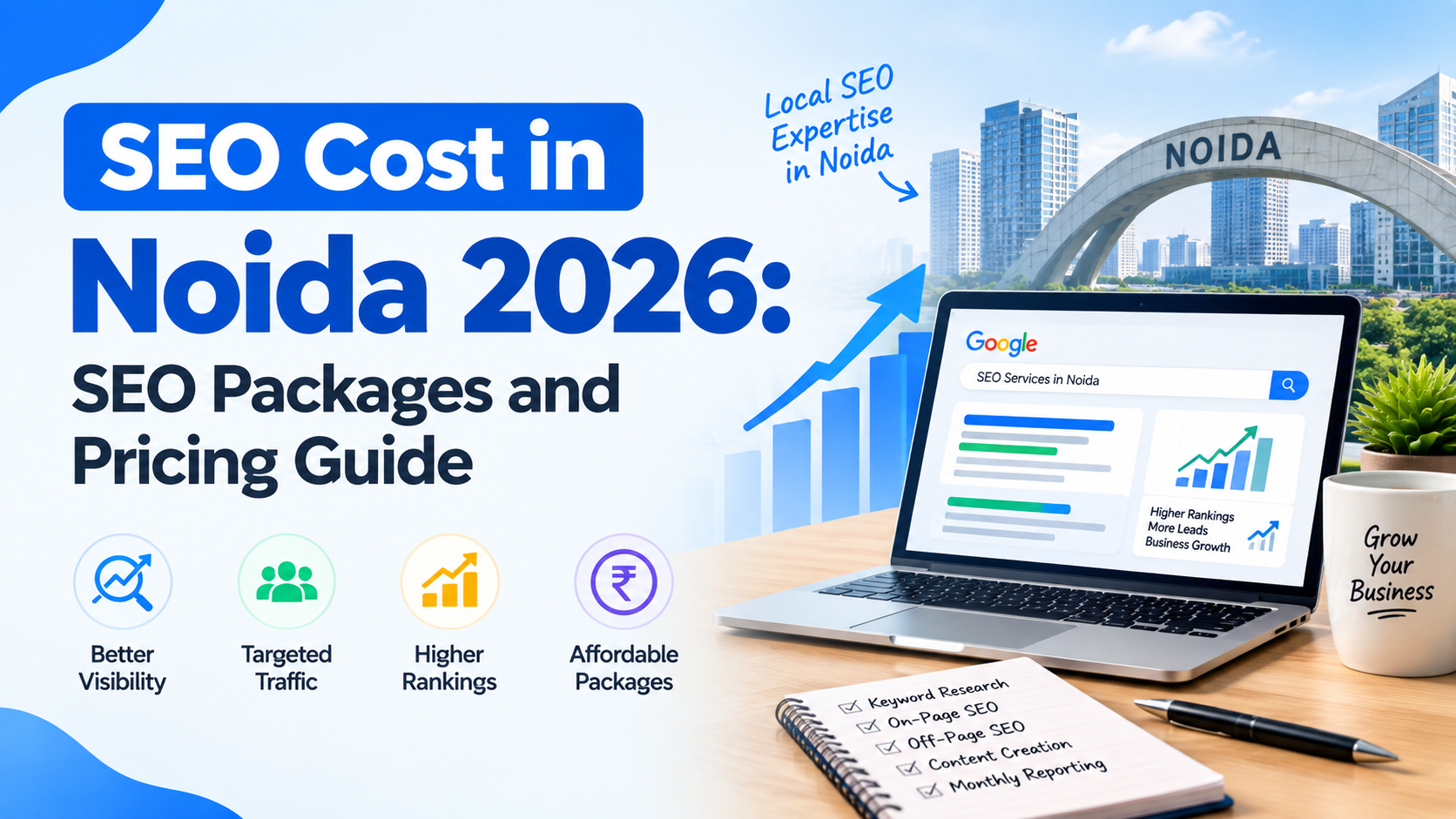
SEO Cost in Noida 2026: SEO Packages and Pricing Guide
The answer depends on the type of business, website size, competition, target keywords and the SEO work required.
Some businesses need basic local SEO while others need complete SEO for a large website or eCommerce store. Because of this, there is no single SEO package that works for every business.
If you are planning to hire an SEO company in Noida, it is important to understand what you are paying for and what work should be included in the package.
SixSoftMedia provides SEO services for businesses that want to improve their Google rankings, website traffic and online visibility.
What Is SEO?
SEO stands for Search Engine Optimization. It is the process of improving a website so that it can appear higher in search engine results.
For example, if you have a business that provides digital marketing services in Noida, you may want your website to appear when people search for:
- Digital Marketing Agency in Noida
- SEO Services in Noida
- SEO Company in Noida
- Digital Marketing Company in Noida
- Local SEO Services in Noida
SEO helps your website target such searches and reach people who are already looking for your products or services.
SEO Cost in Noida in 2026
The SEO cost in Noida can vary depending on the services included in the package.
A basic SEO package may be suitable for a small local business. A medium level package can include more keywords, content and technical SEO work. Large websites and eCommerce businesses may need a more detailed SEO plan.
A general monthly range can look like this:
| SEO Package | Approx Monthly Cost |
| Basic SEO Package | ₹5,000 to ₹10,000 |
| Local SEO Package | ₹8,000 to ₹15,000 |
| Standard SEO Package | ₹10,000 to ₹25,000 |
| Advanced SEO Package | ₹20,000 to ₹40,000+ |
| eCommerce SEO Package | ₹15,000 to ₹50,000+ |
These are general market ranges. The actual SEO package cost depends on the website and the amount of work required.
SEO Packages in Noida
Different businesses have different SEO requirements. This is why an SEO agency usually offers different SEO packages in Noida.
1. Basic SEO Package
A basic package is suitable for small businesses and new websites.
It can include:
- Website SEO audit
- Keyword research
- On-page SEO
- Meta title and description optimization
- Heading optimization
- Image optimization
- Basic technical SEO
- Google Search Console setup
- Monthly SEO report
This package can be useful for businesses that are starting their SEO journey.
2. Local SEO Package
A local SEO package is designed for businesses that want customers from a particular city or location.
For example:
- SEO Company in Noida
- Dentist in Noida
- School in Noida
- Digital Marketing Agency in Noida
- Restaurant in Noida
Local SEO may include Google Business Profile optimization, local keywords, location pages, citations and other local SEO activities.
3. Standard SEO Package
A standard SEO services package is suitable for businesses that want to target more keywords and grow their organic traffic.
It can include:
- Detailed keyword research
- Competitor research
- On-page SEO
- Technical SEO
- Content planning
- Blog content
- Internal linking
- Off-page SEO
- Local SEO
- Google Search Console monitoring
- Monthly reports
This type of package is generally suitable for growing businesses.
4. Advanced SEO Package
Large businesses and websites operating in competitive industries may require an advanced SEO plan.
The work can include:
- Detailed technical SEO
- Large-scale keyword research
- Content strategy
- Competitor analysis
- Content optimization
- Link building
- Website structure improvement
- Conversion-focused SEO
- Local SEO
- Regular performance tracking
The price of an advanced SEO package is higher because more time and resources are required.
Monthly SEO Package
Most businesses prefer a monthly SEO package because SEO is a long-term process.
SEO does not normally provide stable results in a few days. Search engines need time to crawl websites, understand changes and evaluate their content.
A monthly SEO plan allows an agency to work on the website continuously.
The monthly work can include:
- Keyword tracking
- Website optimization
- New content
- Technical SEO
- Internal linking
- Backlink work
- Competitor monitoring
- Traffic analysis
- Search Console analysis
- Monthly reporting
The exact work depends on the package selected.
What Factors Affect SEO Package Cost?
There are several factors that affect the SEO package cost.
Website Size
A website with 20 pages needs less work than a website with 500 or 1,000 pages.
Competition
If many businesses are targeting the same keywords, more SEO work may be required.
For example, ranking for a highly competitive keyword can take more effort than ranking for a low competition local keyword.
Number of Keywords
Targeting 10 keywords and targeting 100 keywords are two different SEO projects.
More keywords usually mean more research, optimization and tracking.
Content Requirement
Content is an important part of SEO. If a website needs regular blogs, service pages and location pages, the package cost can increase.
Technical SEO
Some websites have technical problems related to speed, indexing, mobile usability, broken links or website structure.
Fixing these issues may require additional work.
Backlinks
Backlinks can help a website build authority. The amount and type of off-page work can also affect the monthly SEO cost.
What Should Be Included in an SEO Package?
Before choosing an SEO company, check what is actually included in the package.
A good SEO services package should clearly explain the work being done.
It may include:
- SEO audit
- Keyword research
- Competitor analysis
- On-page SEO
- Technical SEO
- Content optimisation
- Blog creation
- Internal linking
- Off-page SEO
- Local SEO
- Google Business Profile work
- Keyword tracking
- Monthly reporting
Do not select an SEO package only because it has the lowest price.
Always check the quality and type of work included.
Affordable SEO Packages in Noida
Many small businesses search for affordable SEO packages in Noida because they have a limited marketing budget.
An affordable package does not always mean that every SEO activity should be included.
For a small local business, it may be better to start with a focused SEO plan instead of paying for services that are not required.
For example, a local business may first focus on:
- Local keywords
- Google Business Profile
- Service pages
- Location pages
- On-page SEO
- Local citations
- Content
The package can later be increased as the business grows.
SEO Package for Small Business
Small businesses generally do not need the same SEO plan as a large company.
A small business SEO package can focus on a limited number of important keywords and locations.
For example, a business in Noida may target:
- SEO Services in Noida
- SEO Company in Noida
- Digital Marketing Services in Noida
The agency can then optimize the relevant service pages and create useful supporting content.
SEO Package for eCommerce Website
eCommerce websites have different SEO requirements.
An eCommerce SEO package may include:
- Product page optimization
- Category page optimization
- Product keyword research
- Technical SEO
- Internal linking
- Content optimization
- Product schema
- Image optimization
- Search Console monitoring
- Competitor research
Large eCommerce websites may require more technical work because they have hundreds or thousands of product and category pages.
Local SEO Package in Noida
If your business serves customers in Noida or nearby areas, a Local SEO Package in Noida can be useful.
Local SEO focuses on helping your business appear for location-based searches.
For example:
SEO Company in Noida
Digital Marketing Agency in Noida
SEO Services in Sector 62 Noida
SEO Company Near Me
Local SEO can include Google Business Profile optimization, local keywords, location pages and other local search activities.
SEO Services Provided by SixSoftMedia
SixSoftMedia provides digital marketing and SEO services for businesses looking to improve their online presence.
The SEO process can include:
Website SEO Audit
The website is checked for common SEO issues and areas that need improvement.
Keyword Research
Relevant keywords are selected based on the business, target audience and competition.
On Page SEO
Website pages are optimized through titles, descriptions, headings, content, images, URLs and internal links.
Technical SEO
Technical issues related to crawling, indexing, website structure and performance are checked and improved.
Content Marketing
Useful blogs and website content can help target more search queries and provide useful information to potential customers.
Local SEO
Businesses targeting specific cities or areas can work on local search visibility.
Off Page SEO
Off-page activities can help improve the website’s authority and visibility.
How Long Does SEO Take to Show Results?
SEO results depend on many factors.
A new website in a low competition industry may see changes earlier. A website targeting highly competitive keywords may take longer.
The result also depends on:
- Website condition
- Competition
- Keyword difficulty
- Content quality
- Technical SEO
- Backlinks
- Domain history
- SEO work being done regularly
SEO should be treated as a long-term marketing activity rather than a one-time service.
Is Cheap SEO Package a Good Choice?
Not always.
A very cheap SEO package may offer limited work. In some cases, the agency may focus on activities that do not have much value for your business.
Before selecting a cheap SEO package, ask:
- What work is included?
- How many keywords will be targeted?
- Will you get content?
- Is technical SEO included?
- Is local SEO included?
- How will progress be reported?
- Who will manage the SEO work?
- What happens after the first few months?
The right package should match your business needs and budget.
How to Choose the Right SEO Package in Noida?
Choosing an SEO package becomes easier when you first understand your goal.
For a Local Business
Choose a local SEO focused package.
For a New Website
Start with technical SEO, on-page SEO, keyword research and content.
For an Established Website
Focus on improving existing rankings, content and technical issues.
For an eCommerce Website
Choose a package that covers product pages, category pages and technical SEO.
For a Highly Competitive Industry
You may need a larger monthly SEO budget and a longer SEO plan.
Why Choose SixSoftMedia for SEO Services in Noida?
SixSoftMedia works with businesses looking for SEO and digital marketing support.
The focus should not only be on increasing website traffic. The right SEO strategy should also focus on reaching relevant users who can become customers.
With the right SEO plan, businesses can work towards improving:
- Google rankings
- Organic website traffic
- Local visibility
- Website content
- Online presence
- Relevant leads
If you are looking for SEO Services in Noida, SixSoftMedia can help you choose an SEO plan based on your website and business requirements.
Frequently Asked Questions About SEO Cost in Noida
How much does SEO cost in Noida in 2026?
SEO cost in Noida can start from around ₹5,000 per month for basic requirements. More advanced SEO packages can cost ₹20,000 to ₹40,000 or more depending on the website and competition.
What is included in an SEO package?
An SEO package can include keyword research, on-page SEO, technical SEO, content, link building, local SEO and monthly reporting. The exact services depend on the package.
Which SEO package is best for a small business?
A basic or local SEO package can be suitable for many small businesses. The right option depends on the business location, competition and target keywords.
How much does a monthly SEO package cost?
A monthly SEO package can range from around ₹5,000 to ₹40,000 or more. Large websites and competitive industries may require a higher budget.
Is SEO worth the money?
SEO can be useful for businesses that want to generate regular traffic from search engines. However, results depend on the website, competition, keywords and quality of SEO work.
Can I change my SEO package later?
Yes. Businesses can increase or reduce the SEO work based on their requirements and growth.
Does SEO guarantee Google first-page rankings?
No genuine SEO company should guarantee a specific Google ranking. Search rankings depend on many factors and can change over time.
Final Thoughts
The right SEO package is not always the cheapest one. It should provide the work your business actually needs.
In 2026, businesses in Noida have many options for SEO services. Before selecting an agency, compare the services, work process, reporting and overall value of the package.
Whether you need a basic plan, SEO Packages in Noida, local SEO or a complete SEO services package, start with your business goals and then select the right plan.
If you are looking for SEO Services in Noida or a Digital Marketing Agency in Noida, SixSoftMedia can help you plan an SEO strategy according to your website and business requirements.
SEO Services in Noida
Top 15 YouTubers in India with Their Net Worth in 2026
Top 15 YouTubers in India with Their Net Worth in 2026
YouTube has transformed the way Indians consume entertainment, education, technology, comedy and lifestyle content. What started as a platform for uploading videos has evolved into a full-fledged creator economy, where successful YouTubers can build businesses, launch products, work with major brands, enter films and OTT platforms, and generate substantial wealth.
Today, Indian YouTubers are no longer dependent only on YouTube advertising revenue. Their income can come from brand collaborations, sponsorships, merchandise, businesses, music, acting, podcasts, investments, affiliate marketing and other digital ventures.
Several recent rankings also place Technical Guruji (Gaurav Chaudhary), Bhuvan Bam and CarryMinati among the wealthiest Indian YouTube creators, although reported net-worth figures vary considerably between sources.
Important: The net-worth figures in this article are estimated figures based on the data provided and publicly reported estimates. YouTubers generally do not disclose their complete assets, investments, business valuations and liabilities, so actual net worth can be different.
Top 15 YouTubers in India by Estimated Net Worth
| Rank | YouTuber | Channel / Brand | Estimated Net Worth |
|---|---|---|---|
| 1 | Technical Guruji (Gaurav Chaudhary) | Technical Guruji | ₹356 crore |
| 2 | CarryMinati (Ajey Nagar) | CarryMinati | ₹131 crore |
| 3 | Bhuvan Bam | BB Ki Vines | ₹122 crore |
| 4 | Elvish Yadav | Elvish Yadav | ₹80–100 crore |
| 5 | Amit Bhadana | Amit Bhadana | ₹80 crore |
| 6 | Tanmay Bhat | Tanmay Bhat | ₹65–100 crore |
| 7 | Triggered Insaan (Nischay Malhan) | Triggered Insaan | ₹65 crore |
| 8 | Ranveer Allahbadia | BeerBiceps | ₹58 crore |
| 9 | Dhruv Rathee | Dhruv Rathee | ₹58 crore |
| 10 | Sandeep Maheshwari | Sandeep Maheshwari | ₹40–50 crore |
| 11 | Nisha Madhulika | NishaMadhulika | ₹43 crore |
| 12 | Harsh Beniwal | Harsh Beniwal | ₹30 crore |
| 13 | Ashish Chanchlani | Ashish Chanchlani Vines | ₹29 crore |
| 14 | Sourav Joshi | Sourav Joshi Vlogs | ₹25–40 crore |
| 15 | Prajakta Koli | MostlySane | ₹15–20 crore |
The ranking above follows the specific figures supplied for this article. Different 2026 sources publish substantially different estimates—for example, some place Ashish Chanchlani around ₹40 crore and Prajakta Koli around ₹16 crore, illustrating why these numbers should be treated as estimates rather than audited financial statements.
- Technical Guruji – Gaurav Chaudhary
Estimated Net Worth: ₹356 Crore
Gaurav Chaudhary, popularly known as Technical Guruji, is one of India’s most recognizable technology content creators. His YouTube journey helped establish Hindi-language technology content as a major category on the platform.
Technical Guruji became particularly popular for his smartphone reviews, gadget unboxings, technology explanations, comparisons and consumer electronics content. His ability to explain complicated technology in relatively simple language helped him build a massive audience.
He is primarily based in the UAE, and his financial success extends beyond YouTube videos. His income sources are commonly associated with:
- YouTube advertising
- Technology brand partnerships
- Sponsored videos
- Affiliate opportunities
- Business interests
- Investments and other ventures
Several 2026 rankings continue to place Technical Guruji at or near the top of lists of India’s richest YouTubers, with ₹356 crore frequently cited as an estimated figure.
His story demonstrates how a creator can turn expertise in a specific niche into a large digital business.
- CarryMinati – Ajey Nagar
Estimated Net Worth: ₹131 Crore
Ajey Nagar, better known as CarryMinati, is one of India’s biggest digital entertainment personalities.
He became famous for his roasting and commentary videos, but his career has expanded into gaming, live streaming, music and entertainment.
CarryMinati’s popularity comes partly from his distinctive presentation style and highly energetic personality. His gaming-focused content is also associated with his CarryIsLive presence.
His potential income sources include:
- YouTube advertising
- Brand sponsorships
- Gaming partnerships
- Live streaming
- Music
- Merchandise
- Entertainment projects
Estimates vary significantly across publications. Some sources place his wealth around ₹50 crore, while others cite figures closer to ₹131 crore.
For this ranking, we are using the ₹131 crore estimate provided in the supplied data.
- Bhuvan Bam – BB Ki Vines
Estimated Net Worth: ₹122 Crore
Bhuvan Bam is one of the pioneers of India’s YouTube comedy scene.
Through BB Ki Vines, he became famous for portraying multiple characters in comedy sketches, often creating and performing the characters himself. His storytelling and character-driven comedy helped him build an enormous audience.
But Bhuvan’s career didn’t stop with YouTube.
He has successfully expanded into:
- Acting
- Web series
- Music
- Brand endorsements
- Production
- Digital entertainment
His acting projects helped establish him as a mainstream entertainment personality rather than simply a YouTube creator.
Recent reports continue to cite an estimated net worth of around ₹122 crore, although different sources provide different numbers.
Bhuvan’s career is an excellent example of how a YouTube audience can become a launching pad for opportunities in the wider entertainment industry.
- Elvish Yadav
Estimated Net Worth: ₹80–100 Crore
Elvish Yadav has built a huge audience through a combination of vlogging, comedy, social commentary and entertainment content.
His popularity expanded significantly beyond YouTube, particularly through his television and digital entertainment appearances.
Unlike creators who focus on one specific category, Elvish has developed a broader personal brand.
His potential income sources include:
- YouTube advertising
- Brand collaborations
- Sponsorships
- Social media promotions
- Business ventures
- Entertainment appearances
Some published estimates are lower, while others place his wealth around ₹80–100 crore.
The variation illustrates an important point about influencer net worth: audience size does not automatically tell us the actual value of a creator’s assets or businesses.
- Amit Bhadana
Estimated Net Worth: ₹80 Crore
Amit Bhadana is widely regarded as one of the pioneers of Hindi and desi comedy on YouTube.
His videos became popular because they focused on relatable Indian characters, family situations, friendships, relationships and everyday experiences.
Rather than relying heavily on sophisticated production, Amit initially built his audience around storytelling and relatable comedy.
His estimated wealth comes from multiple potential sources, including:
- YouTube advertising
- Brand collaborations
- Sponsored content
- Entertainment projects
- Social media partnerships
Amit Bhadana’s estimated net worth is often reported between approximately ₹58 crore and ₹80 crore depending on the source.
For this article, we use the supplied estimate of ₹80 crore.
- Tanmay Bhat
Estimated Net Worth: ₹65–100 Crore
Tanmay Bhat represents a slightly different model of creator success.
Known originally for his work as a comedian and as a co-founder of All India Bakchod (AIB), Tanmay has evolved into a prominent digital creator, streamer, commentator and investor.
His content today includes areas such as:
- Comedy
- YouTube videos
- Streaming
- Commentary
- Podcasts
- Creator discussions
- Investments
Tanmay’s case is particularly interesting because his financial success isn’t necessarily dependent on YouTube advertising alone.
Some recent online estimates vary dramatically, with certain publications reporting much higher figures.
Because of these inconsistencies, the supplied ₹65–100 crore range is best presented as an estimate rather than a confirmed valuation.
- Triggered Insaan – Nischay Malhan
Estimated Net Worth: ₹65 Crore
Nischay Malhan, popularly known as Triggered Insaan, is one of India’s prominent reaction, commentary and gaming creators.
His content has attracted a massive youth audience through:
- Reaction videos
- Comedy
- Commentary
- Gaming
- Entertainment content
His ability to create content around internet trends and popular topics has helped him maintain strong audience engagement.
Nischay has also benefited from the growth of India’s gaming and streaming ecosystem, giving creators additional opportunities beyond conventional YouTube videos.
Some 2026 estimates put his wealth considerably higher than ₹65 crore, while other rankings provide lower figures.
For this article, the estimated figure is ₹65 crore.
- Ranveer Allahbadia – BeerBiceps
Estimated Net Worth: ₹58 Crore
Ranveer Allahbadia, popularly known as BeerBiceps, built his personal brand around self-improvement, lifestyle and entrepreneurship content before becoming particularly well known for his podcasting work.
His interview platform, The Ranveer Show, has featured personalities from entertainment, business, sports, spirituality and other fields.
His business model demonstrates the evolution of YouTube from a video platform into a broader media business.
Potential income sources include:
- Podcast sponsorships
- YouTube advertising
- Brand partnerships
- Digital media businesses
- Entrepreneurial ventures
- Social media collaborations
His estimated net worth is around ₹58 crore according to the figure used in this article, while other reports also place him in a similar range.
- Dhruv Rathee
Estimated Net Worth: ₹58 Crore
Dhruv Rathee is known for creating educational, explanatory and commentary-based videos covering politics, society, current affairs and international issues.
Based in Germany, he has developed a large audience among viewers interested in long-form explanatory content.
His content model differs considerably from entertainment-focused creators. His videos generally depend on:
- Research
- Explanations
- Commentary
- Educational storytelling
- Current affairs
- Social and political analysis
His estimated net worth in the supplied data is ₹58 crore.
However, public estimates vary significantly. For example, some 2026 rankings place his estimated wealth considerably lower.
This makes it particularly important to describe net-worth figures as estimates rather than verified financial information.
- Sandeep Maheshwari
Estimated Net Worth: ₹40–50 Crore
Sandeep Maheshwari is one of India’s most recognizable motivational speakers and digital educators.
His YouTube presence focuses heavily on motivation, personal development, career guidance, entrepreneurship and life experiences.
Unlike many creators on this list, his digital success is closely connected to his broader entrepreneurial career and ImagesBazaar.
His estimated wealth is approximately ₹40–50 crore according to the supplied data.
His career demonstrates that YouTube can be used not just for entertainment but also as a powerful distribution channel for educational and motivational content.
- Nisha Madhulika
Estimated Net Worth: ₹43 Crore
Nisha Madhulika is one of India’s most successful food and cooking content creators.
She became particularly popular by publishing easy-to-follow recipes that appealed to Indian households.
Her videos cover areas such as:
- Indian vegetarian recipes
- Traditional dishes
- Snacks
- Desserts
- Festival recipes
- Everyday cooking
Her success is especially notable because she built a massive digital audience around a highly focused niche: home cooking.
Her estimated net worth is approximately ₹43 crore.
Nisha Madhulika’s journey demonstrates that creators don’t necessarily need comedy, gaming or technology to build a successful YouTube business. A highly targeted and useful content category can also become extremely valuable.
- Harsh Beniwal
Estimated Net Worth: ₹30 Crore
Harsh Beniwal is a popular comedian, actor and digital creator who developed a strong following among younger Indian audiences.
His content is primarily associated with comedy sketches, relatable characters and entertainment videos.
Over time, his YouTube popularity also helped him transition into acting and other entertainment opportunities.
His estimated net worth is approximately ₹30 crore according to the supplied data.
His career illustrates another important creator-economy trend: successful YouTubers can use their digital audience as a stepping stone into mainstream entertainment.
- Ashish Chanchlani
Estimated Net Worth: ₹29 Crore
Ashish Chanchlani is one of India’s most recognizable comedy creators.
Through Ashish Chanchlani Vines, he became known for highly energetic comedy sketches featuring relatable situations, exaggerated characters and family-oriented humour.
His videos have generated enormous reach and helped him establish a strong personal brand.
His income opportunities can include:
- YouTube advertising
- Brand partnerships
- Sponsored videos
- Entertainment projects
- Acting opportunities
- Digital collaborations
The supplied estimate puts his net worth at ₹29 crore, although several recent rankings place his estimated wealth higher, around ₹40 crore or more.
Therefore, ₹29 crore should be considered the figure used for this particular ranking, not a verified financial valuation.
- Sourav Joshi
Estimated Net Worth: ₹25–40 Crore
Sourav Joshi is one of India’s most prominent daily vloggers.
His content focuses on family life, travel, everyday activities, personal experiences and lifestyle.
The appeal of his videos comes from their simplicity and consistency. Instead of relying on complicated concepts or scripted sketches, Sourav has built a loyal audience by documenting his everyday life.
His estimated net worth is between ₹25 crore and ₹40 crore.
His success highlights the enormous potential of vlogging as a YouTube category in India.
For creators, Sourav Joshi’s journey demonstrates how consistency and audience connection can sometimes be more important than elaborate production.
- Prajakta Koli – MostlySane
Estimated Net Worth: ₹15–20 Crore
Prajakta Koli, known online as MostlySane, is a prominent Indian digital creator who has successfully expanded from YouTube into acting and mainstream entertainment.
She initially gained popularity through relatable comedy and lifestyle content, particularly content exploring everyday Indian experiences.
Over time, her career expanded into:
- Acting
- Web series
- Brand partnerships
- Social media campaigns
- Digital entertainment
- YouTube
Her estimated net worth is around ₹15–20 crore according to the supplied data.
Other sources report figures around ₹16 crore, showing that her estimated valuation falls broadly within this range.
Prajakta is a strong example of how female creators can build influential personal brands and successfully transition into mainstream entertainment.
How Do Indian YouTubers Make Money?
One of the biggest misconceptions about YouTubers is that their wealth comes entirely from YouTube advertisements.
In reality, successful creators usually have multiple revenue streams.
- YouTube Ad Revenue
Creators earn a share of advertising revenue generated from eligible videos. The amount can vary based on:
- Views
- Audience location
- Content category
- Watch time
- Advertiser demand
- Video format
A creator with millions of views doesn’t necessarily earn the same amount as another creator with the same number of views.
- Brand Sponsorships
Brand partnerships can become one of the biggest sources of income for established creators.
Companies pay creators to promote products or services because audiences often trust creators more than traditional advertising.
Technology, finance, beauty, automobiles, food, fashion and consumer products are particularly active areas for influencer marketing.
- Merchandise
Some creators monetize their communities by selling:
- Clothing
- Accessories
- Collectibles
- Digital products
- Other branded merchandise
- Acting and Entertainment
Creators such as Bhuvan Bam, Harsh Beniwal and Prajakta Koli have demonstrated how YouTube popularity can translate into acting opportunities.
- Podcasts
Podcasting has become another major creator-business model. Creators can earn through sponsorships, partnerships and distribution deals.
Ranveer Allahbadia’s podcasting career is a strong example of this transition.
- Businesses and Investments
The wealthiest creators often have income sources outside YouTube itself.
This is particularly important when estimating net worth because a creator’s assets may include:
- Businesses
- Real estate
- Investments
- Equity
- Intellectual property
- Production companies
- Other ventures
Why Is Technical Guruji Considered One of India’s Richest YouTubers?
Technical Guruji’s estimated ₹356 crore figure puts him significantly ahead of many other names in the supplied ranking.
One reason is that his career extends beyond simply uploading videos.
His technology-focused content created a large audience, while his business activities and brand partnerships created additional opportunities.
Recent rankings consistently identify Gaurav Chaudhary as one of India’s wealthiest YouTubers, although exact figures differ between publications.
This demonstrates an important principle of the creator economy:
Audience + personal brand + multiple businesses can be significantly more valuable than YouTube advertising alone.
Does More Subscribers Mean More Money?
Not necessarily.
A YouTuber with fewer subscribers can potentially earn more than someone with a larger audience if their content attracts higher-value advertisers or they have profitable businesses.
For example:
- Technology creators can benefit from electronics partnerships.
- Finance creators can attract financial brands.
- Gaming creators can work with gaming companies.
- Lifestyle creators can attract fashion and consumer brands.
- Business creators can monetize through consulting, courses or investments.
Therefore, subscriber count is only one part of the equation.
What Can We Learn From India’s Richest YouTubers?
There is a common pattern among many of the creators on this list.
They didn’t become successful simply because they started a YouTube channel.
They developed a recognizable personal brand.
Technical Guruji built his reputation around technology.
Bhuvan Bam built characters and stories.
CarryMinati developed a distinctive commentary style.
Nisha Madhulika focused on cooking.
Sourav Joshi focused on daily vlogging.
Dhruv Rathee built an educational/commentary identity.
Ranveer Allahbadia developed a podcast and interview ecosystem.
The lesson is simple:
Successful creators don’t just create videos; they build audiences, brands and businesses.
Final Thoughts
The rise of India’s richest YouTubers shows how dramatically the creator economy has changed.
From ₹15–20 crore estimated fortunes to figures exceeding ₹300 crore, the creators on this list demonstrate the financial potential of building a large and loyal digital audience.
However, it’s important to remember that net worth estimates available online are not official financial statements. Different publications can produce dramatically different numbers because they may use different assumptions about advertising revenue, sponsorships, businesses, investments and assets. Recent rankings themselves show considerable variation in estimates for several creators.
What is much less debatable is the broader trend: YouTube has become a serious career and business platform in India.
The biggest creators are no longer simply YouTubers. They are becoming entrepreneurs, entertainers, actors, investors, podcasters, educators and media personalities.
And as India’s digital audience continues to grow, the creator economy is likely to produce even more millionaires and multi-crore digital entrepreneurs in the years ahead.
Frequently Asked Questions
Who is the richest YouTuber in India?
Based on the estimated figures used in this article, Technical Guruji (Gaurav Chaudhary) is the richest, with an estimated net worth of ₹356 crore.
What is Technical Guruji’s net worth?
Technical Guruji’s estimated net worth is approximately ₹356 crore, although online estimates can vary.
What is CarryMinati’s net worth?
The figure used in this article is ₹131 crore. Other public estimates vary considerably.
What is Bhuvan Bam’s net worth?
Bhuvan Bam’s estimated net worth is approximately ₹122 crore according to the figure used here.
Do YouTubers earn only from YouTube?
No. Major creators can earn through advertising, sponsorships, brand collaborations, businesses, merchandise, acting, podcasts, investments and other ventures.
Are these YouTuber net-worth figures exact?
No. They are estimated figures, not audited financial statements. Actual wealth may be higher or lower depending on assets, businesses, investments, liabilities and other income sources.
Who is the richest YouTuber in India in 2026?
Using the estimates supplied for this article, Technical Guruji ranks first with ₹356 crore, followed by CarryMinati and Bhuvan Bam. Different websites may produce different rankings because creator net-worth estimates are not officially disclosed.
Resources
- InfluencersPlace – Richest YouTubers in India
- Haulpack – Richest YouTubers in India
- Tring – Top Richest YouTubers in India
- India Today – Richest YouTubers in India
- The Economic Times – Bhuvan Bam Net Worth Report
Source note: Net worth figures are estimates based on publicly available reports and may vary between sources.
What Is SMO in Digital Marketing?
What Is SMO in Digital Marketing?
SMO stands for Social Media Optimization. It is an important part of digital marketing that focuses on improving a business’s social media presence.
Today, people spend a lot of time on social media platforms such as Instagram, Facebook, LinkedIn and YouTube. They use these platforms to find brands, check products, read reviews, watch videos and communicate with businesses.
Because of this, simply creating a social media account is not enough. A business needs to keep its profile updated, share useful content and interact with its audience.
This is where SMO becomes useful.
Social Media Optimization helps businesses improve their social media profiles and content so that more people can discover the brand, interact with its content and visit its website or contact the business.
SMO is different from paid advertising. The main focus of SMO is on improving the quality and visibility of a business’s social media presence.
What Does SMO Mean?
SMO means Social Media Optimization.
It includes different activities that help improve a company’s social media profiles and content.
For example, a business can optimize its social media profile by adding correct business information, a clear description, website link, contact details and relevant keywords.
The business can also improve its posts by using suitable images, videos, captions, hashtags and calls to action.
The goal is to make the social media profile useful and easy for people to understand.
Why Is SMO Important in Digital Marketing?
Social media has become an important communication channel for businesses.
People often search for a brand on social media before making a purchase.
They may check the company’s Instagram page, Facebook profile or LinkedIn page to understand the business.
If the profile is incomplete or inactive, it may create a poor first impression.
On the other hand, an active and properly managed profile can help build trust.
SMO can help businesses:
- Improve social media visibility.
- Increase engagement.
- Build brand awareness.
- Improve social media profiles.
- Reach the target audience.
- Bring traffic to the website.
- Encourage people to contact the business.
- Improve communication with customers.
- Support other digital marketing activities.
How Does SMO Work?
- SMO involves several activities.
- The first step is to understand the business and its target audience.
- A business should know who its customers are and which social media platforms they use.
- The next step is to optimize the social media profiles.
- After that, the business can create and publish useful content.
- The content should be relevant to the audience.
- The business should also monitor comments, messages and engagement.
- Performance should be checked regularly to understand what type of content is working better.
- SMO is not about posting randomly.
- It requires proper planning and regular improvement.
Main Parts of SMO
There are several important parts of Social Media Optimization.
- Social Media Profile Optimization
The first step is to make sure the social media profile is complete.
A business profile should clearly explain what the company does.
Important information may include:
- Business name.
- Business description.
- Website link.
- Contact information.
- Location.
- Business category.
- Working hours where relevant.
- Profile image.
- Cover image where applicable.
The information should be accurate and consistent across different platforms.
For example, the company name should not be written differently on every platform.
A consistent profile helps people recognise the brand easily.
- Bio Optimization
The social media bio is important because it gives people a quick idea about the business.
A good bio should clearly explain what the company offers.
For example, a digital marketing company can mention services such as SEO, PPC, social media marketing, content marketing and ORM.
The bio should not be filled with unnecessary keywords.
It should be written for people first.
If a website link is available, it can also be added to the profile.
- Content Optimization
Content is one of the most important parts of SMO.
Businesses need to create content that is useful and interesting for their audience.
Different types of content can be used.
These may include:
- Images.
- Videos.
- Reels.
- Carousels.
- Educational posts.
- Tips.
- FAQs.
- Customer stories.
- Product information.
- Company updates.
- Behind-the-scenes content.
The right content type depends on the business and audience.
For example, a fashion brand may focus more on images and short videos.
A B2B company may use LinkedIn posts, industry information and case studies.
A local service business may share customer experiences, services and useful tips.
- Hashtag Optimization
Hashtags can help organise content and make it easier to discover on platforms that support hashtag search and discovery.
Businesses should use relevant hashtags related to their industry, product, service or location where appropriate.
For example, a digital marketing company serving Noida may use relevant terms related to digital marketing and Noida.
The focus should be on relevance rather than adding a large number of random hashtags.
Using the same set of hashtags on every post may also not always be useful.
Hashtags should be selected according to the content.
- Keyword Use in Social Media
Keywords can also be useful in social media optimization.
Businesses can naturally include relevant words in their profile name, bio, captions and content where appropriate.
For example, if a company provides SEO services, words such as SEO services, search engine optimization and related terms can be used naturally.
The content should still sound normal.
Keyword stuffing can make a profile look unnatural and may not provide a good experience for users.
- Image Optimization
Images are important for social media.
Businesses should use clear and relevant images that match their brand and content.
Images should communicate the main message quickly.
For product businesses, product images should clearly show the product.
For service businesses, graphics can explain services, benefits, tips or processes.
Image size and format should also be suitable for the platform.
A poorly designed or unclear image can reduce engagement.
- Video Optimization
Video content has become an important part of social media marketing.
Businesses can use short videos, reels, tutorials, product demonstrations, customer videos and educational content.
A good video should have a clear purpose.
For example, a company selling industrial equipment can create a video explaining how its equipment works.
A digital marketing agency can create videos explaining SEO, PPC, SMO and other marketing topics.
Video content should provide value instead of being promotional in every post.
- Engagement
SMO is not only about publishing posts.
Engagement is also important.
Businesses should respond to relevant comments and messages.
They can also ask questions, create polls and encourage discussions when suitable.
When people interact with a brand, the company gets an opportunity to understand its audience better.
Customer comments can also provide useful feedback.
- Social Sharing
Businesses should make it easy for people to share useful content.
When people share a useful post with their friends or colleagues, the content can reach a wider audience.
For website blogs, social sharing options can also help visitors share articles on suitable platforms.
However, people should share content because they find it useful.
Businesses should focus on creating content that people naturally want to share.
- Website and Social Media Connection
Social media and the business website should support each other.
A social media profile can link to the company’s website.
A website can also link to the company’s social media profiles.
Businesses can share useful blogs and website pages on social media.
This can help bring visitors from social media to the website.
For example, a company publishes a detailed guide on its website.
It can create a short social media post explaining the main point and then direct interested users to the full guide.
This creates a connection between social media and the website.
SMO and SEO
SMO and SEO are different but they can work together.
- SEO focuses mainly on improving visibility in search engines.
- SMO focuses on improving social media presence.
- SEO can help a website receive organic search traffic.
- SMO can help a business improve its visibility and engagement on social platforms.
For example, a business may publish a blog on its website.
The blog can be optimized for SEO.
The same blog can then be shared on LinkedIn, Facebook or other suitable social platforms.
This allows the business to reach people through both search engines and social media.
SMO and SMM
- SMO and SMM are related but they are not exactly the same.
- SMO stands for Social Media Optimization.
- SMM stands for Social Media Marketing.
- SMO focuses on improving social media profiles and content.
- SMM covers the wider marketing activity on social media.
SMM may include:
- Organic social media marketing.
- Paid advertisements.
- Influencer marketing.
- Content promotion.
- Community management.
- Social media campaigns.
SMO can be considered one part of a wider social media marketing strategy.
In simple words:
SMO means improving your social media presence.
SMM means marketing your business through social media.
Benefits of SMO
SMO can provide several benefits to businesses.
Better Social Media Presence
A properly optimized profile looks more complete and professional.
People can quickly understand what the business does.
More Brand Awareness
Regular and useful content can help more people discover a business.
Better Engagement
Relevant content can encourage people to like, comment, share or save posts.
More Website Traffic
Social media posts can bring interested users to the business website.
Better Customer Communication
Businesses can communicate directly with their audience through comments and messages.
Support for SEO
Social media can help promote website content and bring visitors to the website.
Better Brand Trust
An active and informative social media presence can help create a better impression of the business.
SMO for Small Businesses
Small businesses can benefit from SMO even if they have a limited marketing budget.
They do not need to be active on every social media platform.
They can start with one or two platforms where their target customers are active.
For example, a local clothing store may focus on Instagram and Facebook.
A B2B service company may focus more on LinkedIn.
A restaurant may focus on Instagram and other platforms that work well for local discovery.
The business should select platforms based on its audience.
SMO for Local Businesses
Local businesses can use SMO to connect with people in their target area.
For example, a company serving Noida can create social media content related to its services and local customers.
Location-related information can be added naturally where relevant.
Businesses can also share customer experiences, local offers, new services and useful information.
SMO can work alongside local SEO and other digital marketing activities.
If a business is searching for a digital marketing agency in Noida, it may check the agency’s website as well as its social media profiles before making a decision.
This is why a good social media presence can be useful for service businesses.
SMO for B2B Businesses
B2B businesses can also use SMO.
LinkedIn can be useful for companies that want to reach business owners, professionals and decision makers.
B2B businesses can share:
- Industry updates.
- Company news.
- Case studies.
- Product information.
- Educational content.
- Customer success stories.
- Industry tips.
- Employee and company updates.
- The content should focus on the interests and problems of the target audience.
SMO for E-commerce Businesses
E-commerce companies can use social media to showcase products and communicate with customers.
They can share:
- Product images.
- Product videos.
- New arrivals.
- Customer reviews.
- Product demonstrations.
- Buying tips.
- Offers.
- Frequently asked questions.
- Social media can help customers discover products and visit the website.
- However, the business should not make every post a sales advertisement.
- Useful and engaging content can help keep the audience interested.
SMO for Service Businesses
Service businesses depend heavily on trust.
Customers may want to know about the company before contacting it.
A well-managed social media profile can provide information about the business and its services.
For example, a digital marketing company can share educational posts about SEO, PPC, social media marketing and online reputation management.
This can help potential customers understand the company’s knowledge and services.
Common SMO Mistakes
Businesses often make some common mistakes while managing social media.
Posting Without a Plan
Posting random content without understanding the audience may not provide useful results.
A simple content plan can help maintain consistency.
Using Too Many Hashtags
Adding many irrelevant hashtags does not automatically increase reach.
Relevant hashtags are more useful.
Ignoring Comments
If customers take the time to ask questions or share feedback, businesses should respond where appropriate.
Posting Only Promotional Content
People may lose interest if every post is an advertisement.
Businesses should also share useful and informative content.
Inconsistent Branding
Using different logos, names and business information across platforms can create confusion.
Poor Quality Images
Low-quality images can make the business profile look less professional.
Not Checking Analytics
Businesses should check performance data to understand which content is getting engagement and which content is not working well.
How to Create an SMO Strategy
A simple SMO strategy can follow these steps.
Step 1. Understand the Audience
Find out who your customers are.
Understand their interests, problems and preferred social media platforms.
Step 2. Choose the Right Platforms
Do not try to use every platform.
Focus on the platforms where your audience is active.
Step 3. Optimize Profiles
Update the business name, bio, website link, contact details and other important information.
Step 4. Create Useful Content
Plan content around customer questions, industry topics, products and services.
Step 5. Use Relevant Keywords
Add important business terms naturally in the profile and content where appropriate.
Step 6. Use Suitable Hashtags
Use relevant hashtags based on the platform and content.
Step 7. Engage With the Audience
Reply to useful comments and messages.
Step 8. Track Performance
Check reach, engagement, website visits and other useful metrics.
Step 9. Improve the Strategy
Use the performance data to understand what type of content works better.
Important SMO Metrics
Businesses can track different metrics to understand their social media performance.
Some common metrics include:
- Reach.
- Impressions.
- Likes.
- Comments.
- Shares.
- Saves.
- Follower growth.
- Profile visits.
- Website clicks.
- Messages.
- Leads.
- Engagement rate.
- The most important metric depends on the business goal.
- If the goal is brand awareness, reach may be important.
- If the goal is website traffic, link clicks may be more useful.
- If the goal is lead generation, enquiries and leads may be more important.
SMO and Content Marketing
- SMO and content marketing work closely together.
- Content marketing focuses on creating useful content.
- SMO helps optimize and distribute that content through social media.
- For example, a company may create a detailed blog about a particular service.
- The business can then create several social media posts from that blog.
- One post can explain a common problem.
- Another can share a useful tip.
- A video can explain the same topic.
- A final post can direct users to the complete article.
- This allows one useful piece of content to be used in different formats.
SMO and ORM
- SMO and ORM also work together.
- Social media is one of the places where people talk about businesses.
- Customers may post complaints, questions or positive feedback.
- Regular social media management can help businesses notice these conversations.
- Responding properly can improve customer communication.
- This is why SMO can support Online Reputation Management.
SMO and Paid Social Media
- SMO mainly focuses on improving the organic social media presence.
- Paid social media marketing uses advertisements to reach a selected audience.
- Both can work together.
- For example, a business may create a useful organic post and later promote suitable content through paid advertising.
- However, the content should be relevant to the audience.
How SMO Helps a Digital Marketing Strategy
- SMO is one part of a wider digital marketing strategy.
- SEO can help bring people from search engines.
- Content marketing can provide useful information.
- PPC can provide paid visibility.
- Email marketing can maintain customer relationships.
- ORM can manage online reputation.
- SMO can improve social media presence and engagement.
- Analytics can help measure the results.
- When these activities are planned properly, they can support each other.
Role of a Digital Marketing Agency in SMO
A digital marketing agency can help businesses manage their social media presence.
The work may include profile optimization, content planning, creative content, posting, engagement, hashtag research and performance reporting.
The exact work depends on the business requirements.
A business should clearly understand what is included in the service before starting a campaign.
It should also have clear goals.
For example, the goal may be brand awareness, website traffic, engagement or lead generation.
SMO Services by SixSoftMedia
SixSoftMedia provides digital marketing solutions for businesses looking to improve their online presence.
SMO can be included as part of a wider social media and digital marketing strategy.
The work can focus on improving social media profiles, creating useful content, increasing engagement and connecting social media activity with the company’s website and other marketing channels.
Businesses can combine SMO with SEO, content marketing, PPC, ORM and other Digital Marketing Services depending on their marketing goals.
The right combination depends on the business type, audience, location and budget.
Final Thoughts
SMO stands for Social Media Optimization. It is the process of improving a business’s social media profiles, content and overall presence so that people can discover the brand, understand its services and interact with it.
SMO includes profile optimization, content optimization, keyword use, hashtag selection, image and video optimization, social sharing, audience engagement and performance tracking.
SMO is different from SMM.
SMO focuses on improving the social media presence.
SMM covers the wider activity of marketing a business through social media, including organic marketing and paid advertising.
SMO can also work with SEO, content marketing, ORM, PPC and other digital marketing activities.
For businesses, the main goal should not be simply getting more followers. The focus should be on reaching the right audience, sharing useful content, building trust and getting meaningful results.
A good social media presence takes regular work. Businesses need to understand their audience, create useful content, respond to customers and check their performance regularly.
For businesses looking for a Digital Marketing Agency in Noida, SixSoftMedia can help with social media and other online marketing requirements based on the business goals.
In simple words, SMO helps a business make its social media presence better, more useful and easier for the right audience to discover.
What Is ORM in Digital Marketing? Complete Guide
What Is ORM in Digital Marketing? Complete Guide
ORM stands for Online Reputation Management. It is the process of managing and improving the online reputation of a business, brand or individual. In simple words, ORM helps control what people see and think about a business when they search for it online.
Today, most people check a company online before buying a product or taking a service. They may search the company name on Google, check reviews, visit the website, look at social media pages or read comments from other customers. Because of this, online reputation has become an important part of digital marketing.
A business can have a good website and good products, but if customers find many negative reviews or wrong information online, they may decide not to contact the business. On the other hand, positive reviews, useful content and an active online presence can help create trust.
This is where Online Reputation Management becomes useful.
ORM is not only about removing negative reviews. It is about understanding what people are saying about a business, responding to customers properly, improving the online presence and making sure useful and genuine information is easy to find.
Why Is ORM Important in Digital Marketing?
The internet has changed the way people choose businesses. Earlier, people mostly depended on friends, family or local references. Today, a person can search for a business within a few seconds.
For example, if someone wants to hire a digital marketing company, they may search for the company name and check its website, Google reviews, social media profiles and other online information before making a decision.
This means the online reputation of a business can affect customer decisions.
ORM helps businesses keep track of their online image. It also helps them understand what customers like, what problems they are facing and what areas need improvement.
A good ORM strategy can help a business in several ways.
- It can help build customer trust.
- It can help improve the brand image.
- It can help businesses respond to customer feedback.
- It can help reduce the impact of misleading or incorrect information.
- It can help maintain a positive online presence.
- It can support other digital marketing activities.
How Does Online Reputation Management Work?
ORM involves different activities. There is no single method that works for every business. The strategy depends on the industry, business size, target audience and current online reputation.
The first step is usually monitoring.
A business needs to know what people are saying about it online. This may include Google reviews, social media comments, websites, discussion platforms and other places where customers can talk about the brand.
The next step is understanding the feedback.
Not every negative comment is a serious reputation problem. Sometimes customers simply have a complaint about a delayed service or a small issue. If the business responds properly and solves the problem, the same customer may have a better opinion later.
The third step is taking action.
Businesses can respond to genuine customer concerns, correct wrong information and encourage satisfied customers to share their genuine experience.
The fourth step is building a positive online presence.
This can include useful website content, customer reviews, social media posts, business profiles and other genuine information about the company.
Main Parts of ORM
Online Reputation Management has many parts. Some of the most common ones are explained below.
- Online Review Management
Reviews are one of the most important parts of online reputation.
People often check reviews before buying a product or service. They may look at the overall rating and also read individual reviews to understand the experience of other customers.
Businesses should regularly check their reviews and respond to them.
Positive reviews should be acknowledged with a simple thank you. Negative reviews should also be handled calmly and professionally.
The aim should not be to argue with the customer. The aim should be to understand the issue and provide a proper solution.
For example, if a customer says that a service was delayed, the business can check the issue and reply politely. If the complaint is genuine, the company can apologise and explain how it will solve the problem.
A proper response can show future customers that the company takes customer feedback seriously.
- Google Business Profile Management
Google Business Profile is another important part of ORM for local businesses.
When people search for a business on Google, they may see its business profile, address, phone number, website, photos, working hours and reviews.
An updated business profile can make it easier for customers to find correct information.
Businesses should keep important information updated and monitor customer reviews regularly.
Photos and other business information should also represent the actual business.
- Social Media Reputation
Social media is another place where people talk about brands.
Customers can comment on posts, send messages, share experiences and ask questions. A business that is active on social media should monitor these interactions.
Ignoring customer questions for a long time can create a poor impression.
Businesses should respond to genuine questions and complaints in a simple and respectful way.
Social media can also be used to share useful information about products, services, company updates and customer experiences.
- Managing Negative Feedback
Negative feedback is a normal part of running a business. Even good businesses can receive complaints.
The important thing is how the company handles the complaint.
A business should first understand whether the complaint is genuine. If there is a real problem, the company should try to solve it.
A simple and polite response is usually better than an aggressive response.
Businesses should avoid fighting with customers publicly. If the issue requires personal information or detailed discussion, it may be better to move the conversation to a private channel.
- Positive Content
ORM also involves creating useful and genuine positive content about the business.
This can include blog articles, service pages, customer stories, company information, social media posts and other useful content.
The purpose is not to hide negative information by creating fake content. The purpose is to provide useful information that helps people understand the company better.
For example, a company can publish detailed information about its services, working process, customer support and industry knowledge.
This gives people more information when they search for the brand.
ORM and SEO
ORM and SEO are different but they can work together.
SEO mainly focuses on improving the visibility of a website and its pages in search engines.
ORM focuses on managing the online reputation of a business.
However, both can affect what people see when they search for a company.
Suppose a person searches for a business name. They may see the company website, Google Business Profile, social media profiles, review websites and other pages.
A good ORM strategy tries to make sure that the online information about the company is accurate, useful and positive where possible.
SEO can help useful company pages appear in search results. This is why ORM is often connected with SEO and other digital marketing activities.
ORM and Digital Marketing
ORM is one part of a wider digital marketing strategy.
Digital marketing includes many activities such as SEO, social media marketing, paid advertising, content marketing, email marketing and online reputation management.
All these activities can support each other.
For example, SEO can help a business get more organic traffic. Social media can help the business communicate with customers. Content marketing can provide useful information. ORM can help manage customer feedback and the brand’s online image.
A business does not always need to use every digital marketing activity. The right strategy depends on its goals and target customers.
Benefits of ORM for Businesses
ORM can provide several benefits when it is done properly.
Builds Trust
Trust is very important when customers are choosing a business.
People may feel more comfortable contacting a company when they see genuine positive reviews, useful information and professional responses.
Helps Improve Customer Experience
Customer feedback can help a business understand what customers like and what problems they face.
This information can be used to improve products and services.
Protects Brand Image
Businesses spend years building their brand. A single complaint may not damage a business, but repeated unresolved complaints can create a poor image.
ORM helps businesses monitor such problems and take action.
Helps With Local Business Searches
For local businesses, online reviews and business information can be very important.
People may search for services near their location and compare different businesses.
Having correct business information and genuine customer reviews can help create a better first impression.
Supports Customer Communication
ORM is also about communication.
When a customer asks a question or reports a problem, a proper response shows that the business is listening.
Helps Find Business Problems
Reviews can sometimes reveal problems that the company may not have noticed.
For example, if many customers complain about delayed responses, the company can check its customer support process.
This makes ORM useful not only for reputation but also for improving business operations.
What Is the Difference Between ORM and PR?
ORM and public relations are related but they are not the same.
Public relations mainly focuses on managing communication between a company and the public. It can include media relations, press releases, events and other communication activities.
ORM focuses more on the online reputation of the company.
It looks at online reviews, search results, social media, websites and other online platforms where people discuss the business.
Both can be useful for building a good brand image.
What Is the Difference Between ORM and SEO?
SEO means Search Engine Optimisation. It focuses on improving a website and helping its pages appear in search engine results.
ORM means Online Reputation Management. It focuses on how a business is viewed online and what people find when they search for it.
For example, SEO may focus on ranking a service page for a particular search term.
ORM may focus on managing reviews and improving the information people find about the company.
Both can be used together as part of a digital marketing plan.
Common ORM Activities
Different businesses may use different ORM activities depending on their needs.
Some common activities include:
Monitoring brand mentions.
Checking customer reviews.
Responding to reviews.
Managing Google Business Profile information.
Monitoring social media comments.
Checking search results for the brand name.
Correcting wrong business information.
Creating useful website content.
Publishing genuine customer stories.
Improving customer communication.
Tracking common complaints.
Encouraging genuine customers to leave reviews.
Monitoring competitor reputation.
These activities should be done regularly instead of only when a business receives a negative review.
How to Handle Negative Reviews?
Negative reviews should not always be treated as something that needs to disappear.
First, check the complaint.
If the complaint is genuine, understand what went wrong.
Then respond politely.
Do not blame or insult the customer.
If possible, provide a solution.
If the customer is asked to contact the company privately, make sure the company actually follows up.
A proper response can sometimes turn a bad customer experience into a better one.
Businesses should also avoid buying fake reviews or creating fake customer accounts. Such practices can damage trust and may also violate the rules of platforms where reviews are posted.
Why Genuine Reviews Matter
Genuine customer reviews are more useful than fake reviews.
Customers can often identify reviews that look unnatural or repetitive.
A business should focus on providing a good customer experience first. After that, it can ask satisfied customers to share their honest experience.
Reviews should come from real customers.
The company should not write fake reviews for itself or ask people to post false information.
The goal of ORM should be to build a genuine online reputation.
Role of Content in ORM
Content plays an important role in ORM.
When people search for a company, they may find different pages about the business. Useful content can help provide correct information.
A company can publish blogs, service pages, FAQs, case studies, company updates and other useful content.
For example, if a customer wants to know how a particular service works, a detailed blog can answer the question.
Good content can also help show the knowledge and experience of a business.
However, content should be written for real users first. It should answer real questions instead of being created only for search engines.
ORM for Small Businesses
ORM is not only for large companies.
Small businesses can also benefit from reputation management.
A local shop, restaurant, service provider, consultant or small agency can receive reviews and comments online.
For a small business, every customer can be important. A few negative reviews without proper responses can affect how new customers view the business.
Small businesses can start with simple steps.
They can keep their Google Business Profile updated.
They can check reviews regularly.
They can reply to customer feedback.
They can maintain active social media profiles.
They can publish useful information on their website.
They can ask genuine customers for honest feedback.
These basic steps can help maintain a better online presence.
ORM for Large Businesses
Large businesses usually have more online conversations because they have more customers and wider reach.
They may receive reviews and comments from different cities and platforms.
For such businesses, ORM may require regular monitoring and a proper response process.
Different teams may handle customer support, social media and online reviews.
The company needs to make sure that customer complaints are not ignored.
It should also track common problems and use customer feedback to improve its services.
ORM for Service-Based Businesses
Service businesses depend heavily on customer trust.
For example, a digital marketing agency, software company, consultant, lawyer, repair company or education service may need customers to trust them before making a purchase.
Customers may search the company name before contacting them.
They may check reviews, website information, social media activity and previous work.
This makes ORM important for service-based businesses.
A business should clearly explain what it does, who it serves and how customers can contact it.
It should also make sure that the information available online is correct.
ORM for Local Businesses
Local businesses can benefit from paying attention to their online reputation.
When people search for a business near them, they may compare several options.
Reviews and business information can influence their decision.
For example, someone looking for a marketing company in Noida may check different agencies before contacting one.
A business that has an updated profile, genuine reviews and useful website content may create a better first impression.
This is one reason businesses often include ORM along with local SEO and other digital marketing services.
Steps to Create an ORM Strategy
A simple ORM strategy can be divided into a few steps.
Step 1. Check the Current Reputation
Search the business name on Google and other important platforms.
Look at reviews, social media profiles and other information.
Step 2. Find the Main Problems
Check whether there are repeated complaints or wrong information.
Try to understand what is affecting the business reputation.
Step 3. Monitor Reviews
Regularly check new reviews and comments.
Do not wait for a major problem before checking customer feedback.
Step 4. Respond Properly
Reply to positive and negative reviews in a polite manner.
Try to solve genuine problems.
Step 5. Improve Online Information
Make sure the website, business profile and social media pages have correct information.
Step 6. Publish Useful Content
Create content that answers customer questions and explains the business clearly.
Step 7. Track Changes
Keep checking reviews, search results and customer feedback.
This helps the business understand whether its reputation is improving.
Mistakes to Avoid in ORM
There are some common mistakes that businesses should avoid.
Ignoring Negative Reviews
Ignoring every negative review can make customers feel that the business does not care.
Arguing With Customers
Public arguments can make the situation worse.
It is better to remain calm and professional.
Buying Fake Reviews
Fake reviews can damage trust and create bigger problems later.
Posting Only Promotional Content
People do not want to see advertisements all the time.
Useful information can be more helpful.
Giving False Promises
A business should not make promises that it cannot keep.
Not Monitoring Online Mentions
A company may miss important customer feedback if it never checks what people are saying online.
How Can ORM Improve Brand Image?
Brand image is built over time.
A business cannot create a strong reputation in one day.
It needs consistent customer service, good communication and genuine online activity.
ORM helps by keeping track of customer opinions and online information.
When a company responds properly to feedback and keeps its online information updated, it can create a better impression.
The business should also focus on its actual product or service quality. ORM cannot replace poor customer service or a poor product.
A good reputation starts with a good customer experience.
ORM and Customer Trust
Customer trust is one of the biggest reasons businesses focus on ORM.
When customers see genuine positive feedback and proper responses, they may feel more confident about contacting the business.
For new customers, online information may be their first interaction with the company.
This means a business should make sure its online presence represents the company properly.
The website should provide clear information.
Business profiles should be updated.
Customer reviews should be monitored.
Questions should be answered.
Complaints should be handled properly.
All these small activities can contribute to a better online reputation.
ORM and Business Growth
ORM does not directly guarantee more sales.
However, a good online reputation can support the customer decision-making process.
Suppose two companies offer similar services. A customer may compare their websites, reviews and online presence before choosing one.
If one company has clear information and genuine positive customer feedback while the other has outdated information and many unresolved complaints, the customer may feel more comfortable with the first company.
This shows why reputation can be important when customers are comparing businesses.
Role of a Digital Marketing Agency in ORM
A digital marketing agency can help businesses manage different parts of their online presence.
The agency can monitor reviews, manage social media, work on SEO, create content and track online brand mentions.
The exact services depend on the needs of the business.
For companies that do not have an internal digital marketing team, working with an agency can make it easier to manage these activities regularly.
If a business is searching for a digital marketing agency in Noida, it can compare agencies based on their services, experience, work process and genuine customer feedback.
Before selecting an agency, businesses should understand what services are included and what results can realistically be expected.
Why ORM Should Be a Regular Activity
Online reputation can change over time.
A company may have good reviews today but receive new complaints later.
New social media posts can also change how people see the business.
Search results can change as new pages are published.
Because of this, ORM should not be treated as a one-time activity.
Regular monitoring helps businesses find problems early.
It also gives them an opportunity to respond to customer feedback and keep their online information updated.
ORM for New Businesses
New businesses should start working on their online reputation from the beginning.
They should create accurate business profiles, build a useful website and maintain active communication with customers.
When they start receiving genuine customer feedback, they should monitor it regularly.
A new business does not need hundreds of reviews immediately.
It should focus on providing good service and building genuine customer relationships.
Over time, satisfied customers can share their experiences.
ORM for Established Businesses
Established businesses may already have many reviews and online mentions.
For them, the main challenge can be managing the large amount of information available online.
They should identify the most important platforms where customers talk about the business.
They should also check whether old information is still correct.
If the business has changed its address, phone number, services or working hours, online profiles should be updated.
This can reduce confusion for customers.
How to Measure ORM Performance?
Businesses can track different things to understand how their online reputation is changing.
Some useful areas to monitor include:
- Number of new reviews.
- Review ratings.
- Customer responses.
- Common complaints.
- Brand mentions.
- Social media comments.
- Search results for the company name.
- Website traffic from branded searches.
- Customer feedback.
- The exact metrics depend on the business.
- There is no single number that can tell the complete story of online reputation.
- It is better to look at different signals together.
Is ORM Only About Google Reviews?
No.
Google reviews are important for many businesses, especially local businesses, but ORM is much wider than Google reviews.
People may talk about a business on social media, forums, review websites, blogs and other online platforms.
They may also publish their experience on their own social media accounts.
ORM involves monitoring the wider online presence of the brand.
Can ORM Remove Negative Reviews?
A business should not assume that every negative review can or should be removed.
If a review breaks the rules of the platform, the business can report it through the proper process.
But a genuine negative review should generally be handled through a proper response and customer support.
Trying to remove every negative opinion is not a practical reputation strategy.
A better approach is to understand the problem, solve genuine issues and continue building a good customer experience.
ORM and Social Proof
Social proof means people often look at the experiences of others before making a decision.
Reviews are one example of social proof.
Customer testimonials and genuine case studies can also help people understand what others experienced with a business.
Businesses can use genuine customer feedback as part of their website and marketing activities where appropriate.
The information should always be truthful.
Final Thoughts
ORM in digital marketing means Online Reputation Management. It helps businesses monitor, manage and improve their online reputation.
It includes activities such as review management, customer communication, social media monitoring, Google Business Profile management, content creation and checking online brand mentions.
ORM is not about hiding every negative comment or creating fake positive reviews. It is about building a genuine and trustworthy online presence.
A business should first focus on providing a good product or service. After that, it should listen to customers, respond to feedback and keep its online information updated.
ORM can work well with SEO, social media marketing, content marketing and other digital marketing activities. Together, these activities can help a business maintain a better online presence and make it easier for customers to understand and trust the brand.
For businesses looking for professional online marketing support, SixSoftMedia provides different digital marketing solutions based on business needs. A proper strategy can include SEO, content, social media, reputation management and other online marketing activities.
In simple words, ORM is about taking care of your brand’s image on the internet. When people search for your business, they should be able to find correct information, genuine customer experiences and useful content that helps them make a better decision.
SEO vs AEO vs GEO What Is the Difference
SEO vs AEO vs GEO What Is the Difference
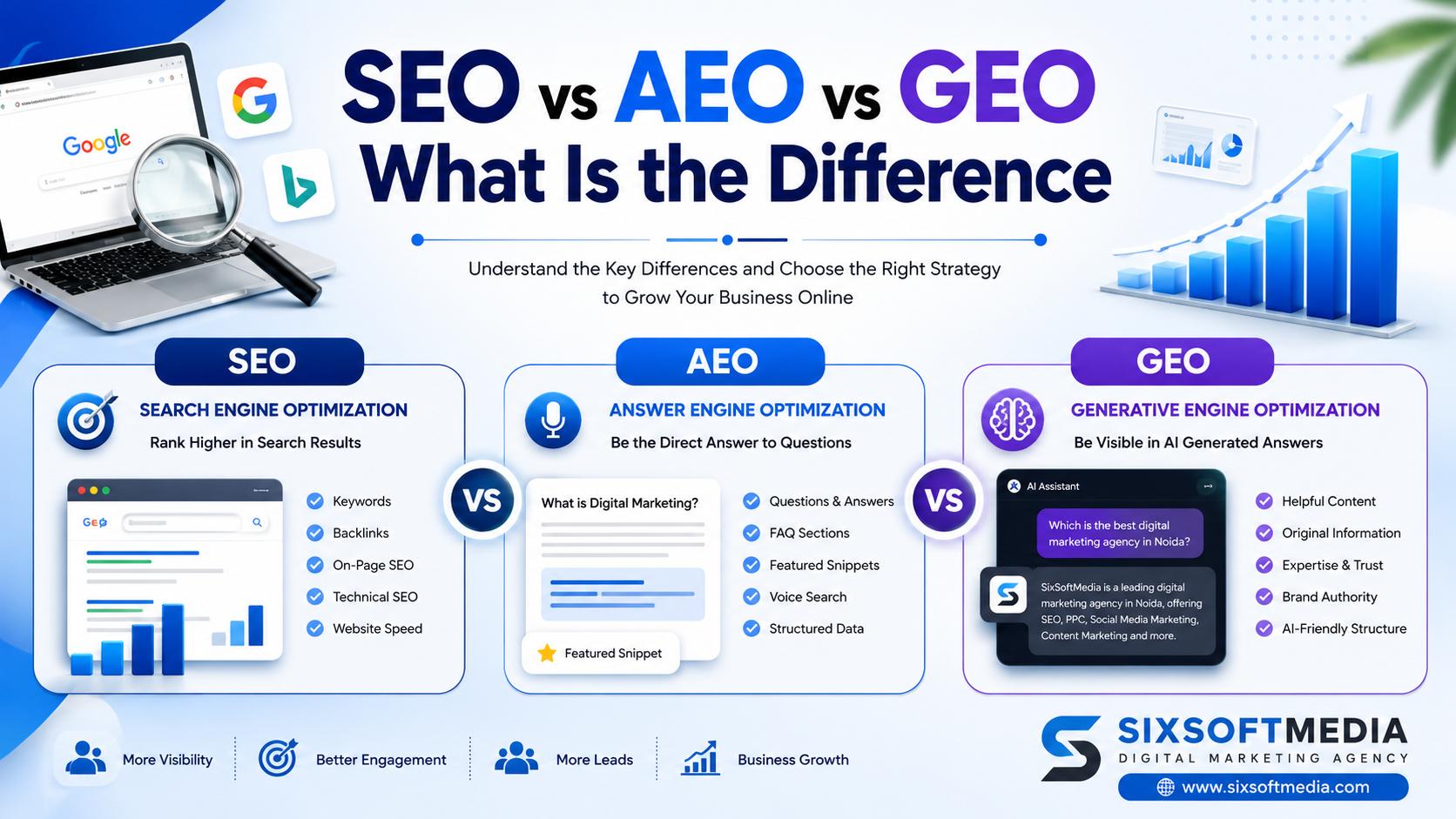
Search engines are changing very fast. A few years ago businesses only focused on SEO. If a website ranked on the first page of Google then it could get good traffic and more customers.
Today the way people search has changed. Many people now ask questions on ChatGPT Google AI Overview Gemini and Perplexity. Instead of clicking many websites they want one simple answer.
Because of this businesses need to understand three important terms.
- SEO
- AEO
- GEO
These three methods help your business become more visible online. They are different but they work best when used together.
If you want your business to get more traffic more leads and more customers then you should know how SEO AEO and GEO work.
What Is SEO
SEO means Search Engine Optimization.
SEO is the process of improving your website so it ranks higher in search engines like Google and Bing.
The main goal of SEO is to bring free organic traffic to your website.
When someone searches for your products or services your website should appear before your competitors.
For example if someone searches
Digital Marketing Agency in Noida
A website with good SEO has a better chance of appearing on the first page.
SEO is still one of the most important digital marketing strategies because millions of people use Google every day.
Important Parts of SEO
- Keyword research
- High quality content
- Fast website speed
- Mobile friendly design
- Internal linking
- Image optimization
- Technical SEO
- Quality backlinks
- User friendly website
- Regular content updates
Good SEO helps search engines understand your website and show it to the right audience.
What Is AEO
AEO means Answer Engine Optimization.
The goal of AEO is not only to rank your website.
The goal is to become the direct answer to a user’s question.
Today many people search by asking complete questions.
For example
- What is SEO
- How does digital marketing work
- Which school is best in Noida
- How to improve website ranking
Google often displays a short answer above the normal search results.
Voice assistants also read these answers.
If your content is written clearly your website has a better chance of becoming that answer.
Important Parts of AEO
- Simple language
- Question based headings
- FAQ section
- Short answers
- Structured content
- Schema markup
- Easy to read paragraphs
The easier your content is to understand the better your chances of appearing as an answer.
What Is GEO
GEO means Generative Engine Optimization.
This is the latest type of optimization.
It focuses on AI powered search platforms.
Examples include
- ChatGPT
- Google AI Overview
- Google Gemini
- Microsoft Copilot
- Perplexity AI
These AI tools collect information from trusted websites and create one detailed answer for users.
Instead of showing only links AI gives complete responses.
If your content is useful original and trustworthy AI may use your website as one of its information sources.
That is why GEO has become very important for modern businesses.
Why GEO Matters
AI search is growing every month.
Many users now ask questions directly to AI instead of searching Google in the traditional way.
Businesses that create helpful content have a better chance of being mentioned by AI platforms.
This increases brand awareness.
It also builds trust because users see your business as an expert.
Important Parts of GEO
- Original content
- Helpful information
- Real examples
- Expert knowledge
- Updated articles
- Strong brand authority
- Clear content structure
- Trusted website
- Accurate information
The better your content helps users the better your chances of appearing in AI generated answers.
SEO vs AEO vs GEO
Although these three methods are connected they have different goals.
SEO
SEO helps websites rank higher in search engine results.
It mainly focuses on keywords backlinks technical improvements and website performance.
AEO
AEO focuses on answering user questions quickly.
It improves your chances of appearing in featured snippets and voice search results.
GEO
GEO helps AI understand your content.
It increases the possibility that AI platforms will include your website in their generated answers.
Simple Comparison
| SEO | AEO | GEO |
| Improves search rankings | Gives direct answers | Improves AI visibility |
| Focuses on keywords | Focuses on questions | Focuses on helpful content |
| Targets Google and Bing | Targets answer engines | Targets AI platforms |
| Increases website traffic | Increases answer visibility | Increases AI mentions |
| Uses backlinks and technical SEO | Uses FAQs and structured content | Uses expertise and trust |
Can SEO Work Without AEO and GEO
Yes.
But it is no longer enough.
Many businesses still focus only on SEO.
This means they may rank well in Google but miss opportunities in AI search and voice search.
Modern digital marketing requires all three strategies.
How SEO Helps Your Business
SEO offers many long term benefits.
- More organic traffic
- Better Google rankings
- More brand awareness
- Higher website authority
- More qualified leads
- Better return on investment
SEO is the foundation of online marketing.
Without SEO it becomes difficult for customers to find your website.
How AEO Helps Your Business
AEO improves user experience because visitors get quick answers.
Benefits include
- Better visibility in Google
- More voice search traffic
- Higher click through rate
- Improved user trust
- Better mobile search performance
People like quick answers.
AEO helps you provide them.
How GEO Helps Your Business
GEO prepares your website for the future of search.
Benefits include
- Better AI visibility
- More brand mentions
- Higher authority
- Improved trust
- More qualified visitors
- Better online reputation
As AI search continues to grow GEO will become even more valuable.
Best Practices for SEO
Follow these tips.
- Research the right keywords
- Write useful blogs
- Improve page speed
- Build quality backlinks
- Add internal links
- Optimize images
- Keep your website mobile friendly
- Update old content regularly
Best Practices for AEO
Follow these methods.
- Answer common customer questions
- Use question based headings
- Write simple answers
- Add FAQ sections
- Use structured data
- Keep paragraphs short
These steps improve your chances of appearing in featured snippets.
Best Practices for GEO
To improve GEO you should
- Publish original content
- Share practical knowledge
- Write detailed guides
- Add real examples
- Show author expertise
- Update content regularly
- Build brand credibility
- Create helpful resources
AI prefers websites that provide value instead of only promoting products.
Why Businesses Should Use All Three
The customer journey has changed.
Some people search on Google.
Some ask Siri or Google Assistant.
Some open ChatGPT.
Some use Google AI Overview.
Some prefer Perplexity.
If your business only focuses on one platform you may lose potential customers.
Using SEO AEO and GEO together gives your business better visibility across all modern search platforms.
How SixSoftMedia Can Help
At SixSoftMedia we understand that digital marketing is changing every day.
Our team creates SEO friendly AEO ready and GEO optimized content that helps businesses reach more customers.
We focus on
- Keyword research
- Content writing
- Technical SEO
- On page SEO
- Local SEO
- AI friendly content
- Link building
- Website optimization
Our goal is to help businesses generate quality leads through modern digital marketing strategies.
Final Thoughts
SEO AEO and GEO are not competing strategies.
They work together to improve your online presence.
SEO helps your website rank higher in search engines.
AEO helps your content become the direct answer to customer questions.
GEO helps AI platforms understand your content and include it in AI generated responses.
Businesses that invest in all three strategies are better prepared for the future of digital marketing.
If you want more traffic more leads and stronger online visibility then now is the right time to include SEO AEO and GEO in your digital marketing strategy.
Whether your customers search on Google use voice search or ask AI tools your business should be ready to provide the right answer at the right time.
How to Appear in Google AI Overviews 2026 Guide
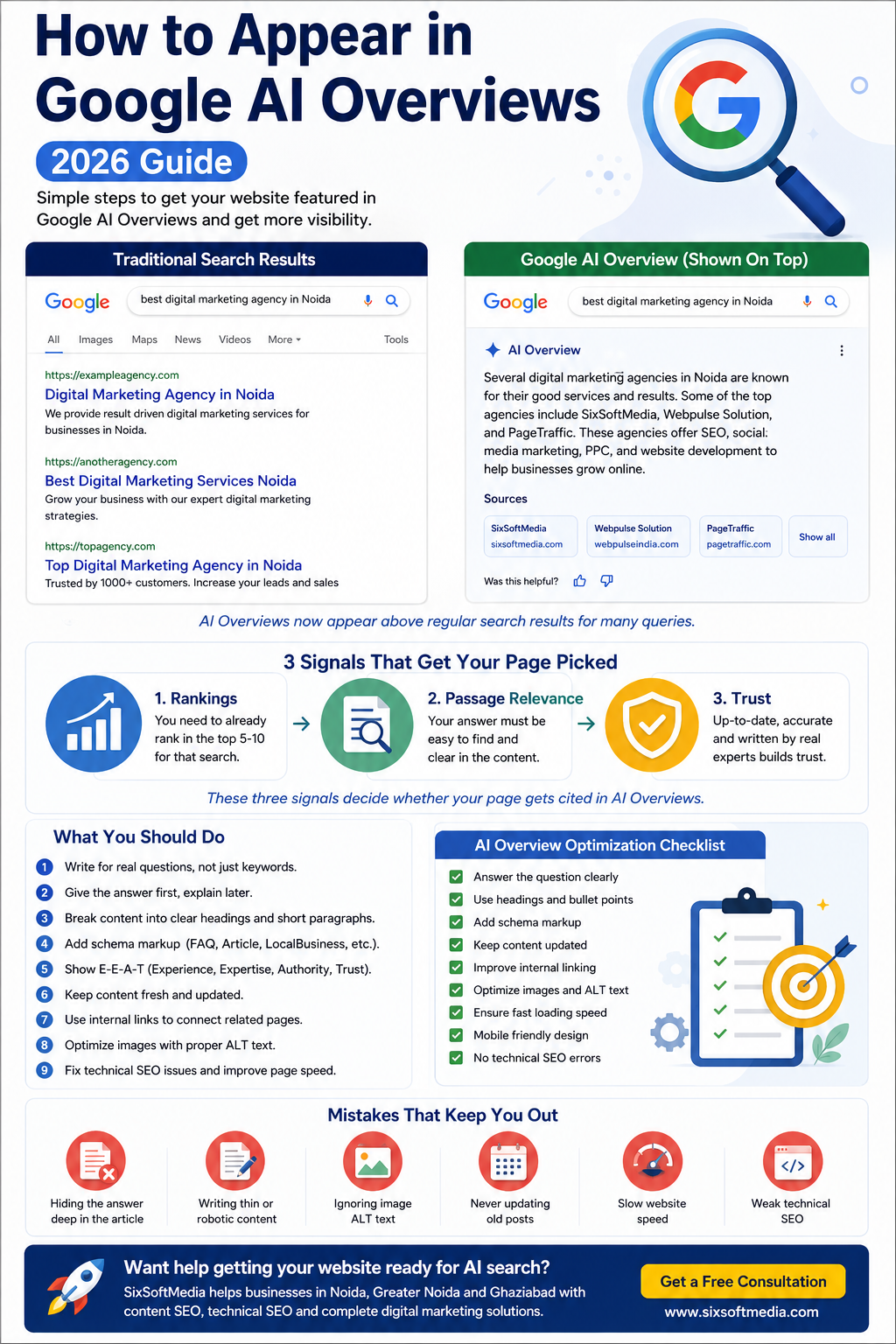
SEO vs GEO: What Your Business Needs in 2026
SEO vs GEO: What Your Business Actually Needs in 2026
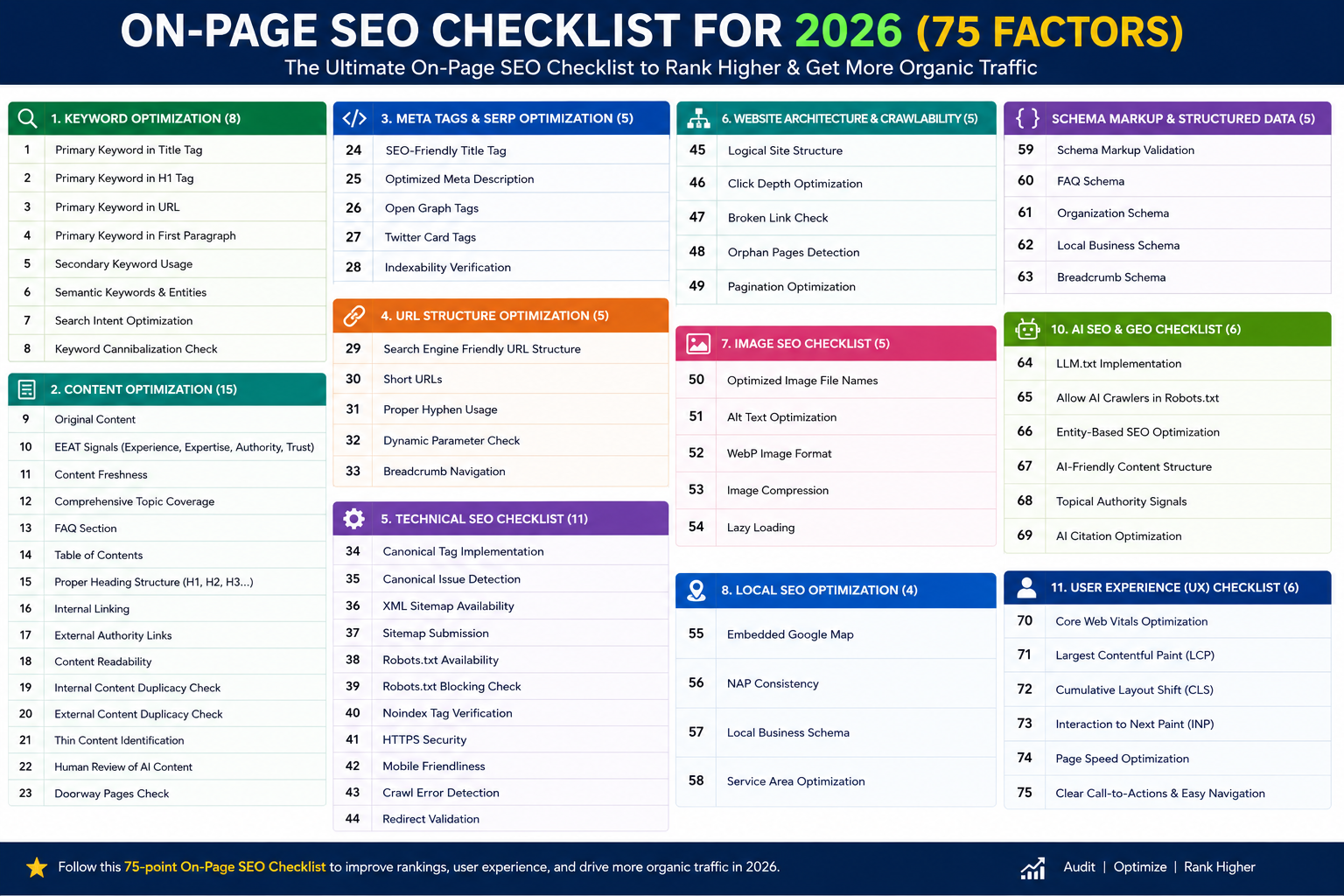
Search has changed. People no longer only type a keyword into Google and click a blue link. Many now ask ChatGPT, Gemini, or Perplexity a direct question and expect a direct answer.
This shift has created a new term: GEO, or Generative Engine Optimization. If you run a business in Noida or anywhere in India, you have probably heard both “SEO” and “GEO” this year. But what do they actually mean? And do you need both?
This guide breaks it down in plain language, without the jargon.
What is SEO?
SEO stands for Search Engine Optimization. It is the practice of improving your website so it ranks higher on Google’s results page.
When someone searches “digital marketing agency in Noida,” SEO decides which websites show up in that list of 10 blue links. Good SEO covers:
- Keyword research and on-page content
- Technical site health (speed, mobile-friendliness, security)
- Backlinks from other trusted websites
- Local SEO signals (Google Business Profile, reviews, citations)
SEO has been the backbone of online visibility for over 20 years. It still is. But it is no longer the only game in town.
What is GEO?
GEO stands for Generative Engine Optimization. It is the practice of structuring your content so AI tools like ChatGPT, Gemini, Claude, and Perplexity pick it up and mention it when answering a user’s question.
Here is the key difference: Google gives users a list of links to choose from. AI tools give users one direct answer, built from multiple sources. GEO is about making sure your business is one of those sources.
Some people also call this AEO (Answer Engine Optimization) or AI SEO. The names are different, but the goal is the same — get your brand mentioned inside the AI’s answer, not just ranked in a list.
SEO vs GEO: The Real Difference
| Point | SEO | GEO |
| Goal | Rank on Google’s results page | Get cited inside AI-generated answers |
| Success metric | Ranking position, clicks | Citation frequency, brand mentions |
| Where it shows up | Google, Bing search results | ChatGPT, Gemini, Perplexity, AI Overviews |
| Core need | Keywords, backlinks, technical SEO | Clear structure, facts, authority, easy-to-quote content |
| User action | Clicks your website | Reads the AI’s answer, may never visit your site |
The good news is that both are built on the same foundation. Well-structured, factual, helpful content tends to perform well in both Google search and AI answers. You are not choosing one over the other. You are building on what you already have.
Why GEO Matters for Your Business in 2026
A growing number of people now start their research on AI tools instead of Google. When someone asks an AI tool “which is the best digital marketing agency near me” or “how much does SEO cost in Noida,” the AI gives one answer. If your business is not part of that answer, that customer never even sees your name.
This matters more for local and service businesses than most owners realise. Someone researching a dentist, a real estate agent, or a marketing agency is increasingly likely to ask an AI tool first, then verify with a quick Google search.
If your content is not built for AI to read and quote, you lose that first impression entirely.
How GEO Actually Works
AI tools do not work the same way as Google’s ranking algorithm. Understanding the process helps you write content that gets picked up.
- Crawling – AI tools crawl and index web pages, similar to how Google does, though the crawlers are different (GPTBot, PerplexityBot, ClaudeBot, and so on).
- Parsing – The AI breaks your page into small, meaningful chunks — a definition, a step, a fact, a comparison.
- Synthesizing – When a user asks a question, the AI pulls the most relevant, clearly written chunks from multiple sources and combines them into one answer.
This means clarity matters more than clever writing. If your answer to a question is buried in the fifth paragraph after a long story, the AI is less likely to use it.
How to Optimize for GEO (Practical Steps)
- Answer the question in the first 40-50 words Start every section with a direct, simple answer. Add detail after. AI tools tend to pull from the top of a section first.
- Use clear headings that match real questions Instead of a heading like “Our Approach,” use “How Does SEO Pricing Work in Noida?” Questions as headings make it easier for AI to match your content to a user’s query.
- Build topical depth, not single articles One blog post rarely builds authority. A cluster of connected pages covering a topic from every angle signals real expertise, both to Google and to AI tools.
- Add real facts, numbers, and sources AI models favour content with specific, checkable information over vague claims. “We increased organic traffic by 320% in 6 months” performs better than “we deliver great results.”
- Use structured data (schema markup) FAQ schema, Article schema, and LocalBusiness schema help both search engines and AI tools understand your content quickly and accurately.
- Keep content fresh Citations inside AI answers change often, sometimes month to month. Updating your content regularly keeps you in the running.
- Make sure AI crawlers can access your site Many websites accidentally block GPTBot, PerplexityBot, or ClaudeBot through bot-protection settings. Check your robots.txt file to confirm these crawlers are allowed in.
- Build genuine authority signals Reviews, mentions on other trusted sites, author bios with real credentials, and consistent business information across the web all help AI tools trust your content enough to cite it.
Do You Need to Choose Between SEO and GEO?
No. This is not an either-or decision. GEO builds directly on the same foundation as SEO — useful content, a fast and secure website, and clear structure. If your SEO fundamentals are weak, your GEO performance will be weak too.
Think of it this way: SEO gets you found. GEO gets you mentioned. A serious digital marketing strategy in 2026 needs both working together, not one replacing the other.
What This Means for Noida Businesses
Local businesses in Noida, Greater Noida, and Ghaziabad are still mostly competing on traditional local SEO — Google Maps rankings, reviews, and local keyword pages. That part has not changed.
What has changed is the extra layer on top. When someone searches “best digital marketing agency near me” on ChatGPT instead of Google, your website’s structure, clarity, and authority signals decide whether you get mentioned. Businesses that get ahead of this now will have a real advantage over competitors who wait.
Frequently Asked Questions
Is GEO replacing SEO? No. GEO is an extra layer built on top of SEO, not a replacement. Content that already ranks well on Google tends to perform well in AI answers too.
What is the difference between GEO and AEO? AEO (Answer Engine Optimization) focuses on Google’s direct-answer features like AI Overviews and featured snippets. GEO focuses on fully generative tools like ChatGPT and Perplexity. In practice, most businesses treat them as the same discipline.
Do I need special tools to start with GEO? Not necessarily. You can start by asking ChatGPT, Gemini, and Perplexity 10-15 questions relevant to your business and checking if your website gets mentioned. This shows you where you stand today.
How long does it take to see GEO results? It varies by platform. Gemini tends to reflect strong existing SEO quickly. Other platforms, like Claude, can take several weeks to a few months to pick up and trust new content.
Does my website need to rank on Google to appear in AI answers? Not always, but it helps a lot. AI tools often lean on the same authority and quality signals that traditional search algorithms use, so strong SEO makes GEO easier.
Can a small business in Noida compete with bigger agencies on GEO? Yes. GEO rewards clear, factual, well-structured content more than sheer website size. A smaller business with focused, honest content can be cited just as easily as a large one.
Conclusion
SEO is not going away, and GEO is not a passing trend. Together, they decide whether your business shows up when someone searches on Google or asks an AI tool a question. The businesses that adapt their content now, with clear answers, real facts, and solid structure, will be the ones customers find first, however they choose to search.